How and when is the union of the Churches achieved? What is the sign that proves and confirms it? Is it perhaps the common prayers among all Christians? No, but something else, which we shall see below.
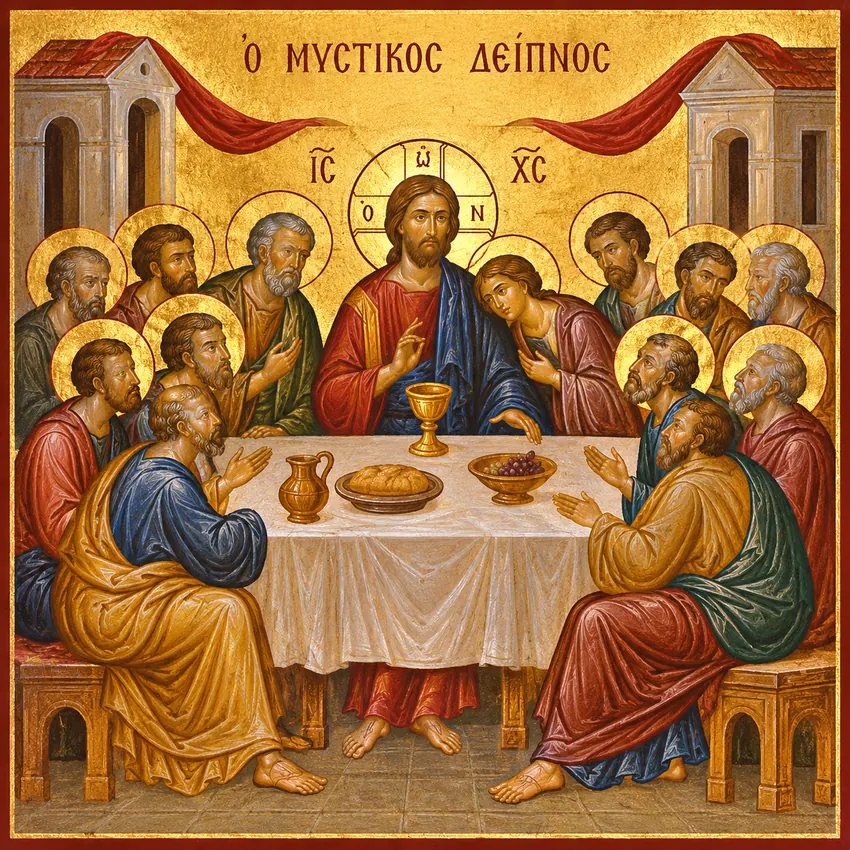
In the ancient Church, there was a custom, particularly in the Church of Rome, whereby, when the Bishop celebrated the Divine Eucharist, he would send through his deacons a “portion” of the consecrated Bread to the parishes, as a sign of the unity of the Church. (A remnant of this custom is what continues to take place to this day in the Orthodox Divine Liturgy. After the consecration, the Priest divides the Bread and places one “portion” in the Holy Chalice, saying, “The fullness of the Chalice.”)
At the same time, the Bishops in the early days of the Church did something else as well. On Easter Sunday, they would send one another consecrated Bread as a sign of unity. When Victor, Bishop of Rome, refused to observe this custom, Saint Irenaeus, Bishop of Lyons, rebuked him, writing to him: “Your predecessors (Anicetus, Hyginus, Telesphorus, Xystus) used to send the Eucharist to the Bishops of Asia, and how dare you exclude them from communion?” (Saint Nicodemus the Hagiorite, Commentary on Canon XIV of Laodicea, 26, and Eusebius, Ecclesiastical History, Book V, 24, “Concerning the Disagreement in Asia,” P.G. 20:505). Eventually, for practical reasons, this custom was abolished by the Council of Laodicea (381). “Concerning the prohibition against sending the Holy Gifts to other parishes in the form of blessings during the feast of Easter” (Canon XIV).
It is also noteworthy that, according to the Eighth Apostolic Canon, when the Mystery of the Divine Eucharist was celebrated and a Priest (not a layperson) did not receive Holy Communion, he was required to explain to the assembly the reason for not receiving Communion. According to the circumstances of that time, the purpose of this explanation was to declare whether he shared the same faith as the Priest celebrating the Liturgy.
The above demonstrates that the unity of the Church is expressed through the Divine Eucharist, through the “Common Chalice.” Therefore, as long as there is no “Common Chalice,” there is no union of the Churches, regardless of how many common prayers take place or what form they may take.
However, attention must be paid to something important. The Common Chalice is the fruit, the result, of a common Faith. If there is no common and correct faith, there can be no Common Chalice. In other words, for there to be a Common Chalice, there must first be a common and correct faith. And the question is how this common and correct faith will be “discovered.”
Let us suppose that ten Christians are together, sharing the same faith, united as one body, like a single family. They live in the same house, eat at the same table, and this is how their life proceeds. One of them begins to question the faith, wishing to add something new. He cannot reach an agreement with the others, so he leaves them, follows his own path, and forms his own group. A second person does the same, and then a third does likewise. For this group to become once again what it was before, one family, these three must accept the common faith they originally shared, return to the family, and eat together again.
Something similar applies to the union of the Churches. Those who separated themselves from the Church by changing their faith must accept the faith they held before their separation. In this way, they will participate in the “Common Chalice,” thereby sealing their union with the One Church.
Is it difficult? If there is no willingness and humility, it is not merely difficult, but impossible.
The devil desires division, Christ desires unity.
Leave a Reply