
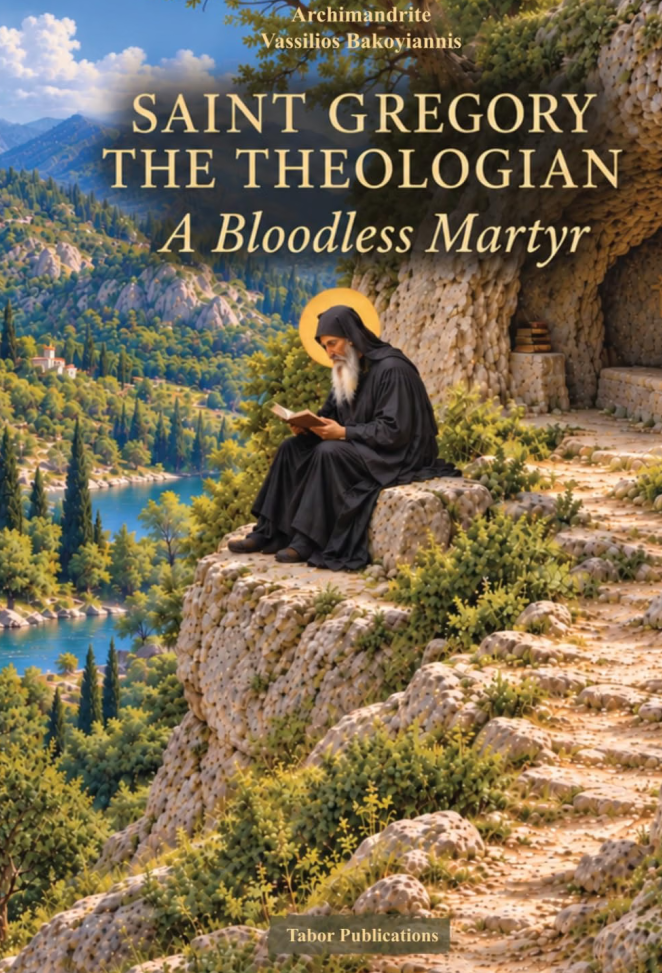
Prologue
Gregory wrote to his friend Basil: “For me, the greatest action is inaction,” that is, stillness (Letter 49, P.G. 37:101). A life of solitude was in his nature. And he sacrificed his nature in order to serve the Church. He was a bloodless martyr.
We present a few, but essential, details from his life, in the hope that we may further “expand” on them by delving more deeply into each one.
“O Saint of God, intercede for us.”
PART I
15. The “Epilogue” of His Life (pp. 54–56, excerpt)
Gregory’s father had passed away, and Nazianzus was still without a shepherd. This presented Gregory with an opportunity to become bishop of his homeland. Yet such ambitions belong to people whose hearts remain attached to worldly things. Gregory, on the contrary, had died to the world, and the world had died to him. (…)
Gregory then appealed to Helladius, Archbishop of Caesarea and successor to St. Basil the Great, asking him to appoint a bishop for Nazianzus. Eulalius was subsequently elected.
Meanwhile, two years had passed since the death of his friend Basil, who was already being venerated as a saint. On the day of his commemoration, January 1, 382, Gregory went to Caesarea, attended the celebration, and delivered his famous funeral oration in honor of Basil.
He then returned to Arianzus, where he remained for about five years, continuing his ascetic way of life. One year, during Great Lent, he kept his mouth completely shut, observing absolute silence. “Together with Christ I put my tongue to death, and together with Him I raised it to life again” (St. Gregory the Theologian, Letter 119, To Palladius, P.G. 37:213). Through this silence, he learned many things. He gained an even deeper understanding of when to speak and when to remain silent and thus grew wiser.
It seems that the crowds of visitors who flocked to see him prevented him from enjoying the peace and solitude of the seclusion he had chosen. He therefore withdrew to the remote village of Karvali, in what is now central Turkey. However, when a monastery began to be built in Karvali, Gregory felt compelled to leave once again and seek refuge in a secluded and inaccessible region. This was to be his final dwelling place.
It was winter, January of the year AD 390. The path leading to Gregory’s hermitage was covered with snow. His spiritual children, Eustathius and Eupraxius, went in search of him. Some shepherds cleared a path through the snow and guided them to Gregory’s solitary cell. They found him on the brink of death. Shortly afterward, he passed away in the wilderness.
His memory is celebrated on January 25.
“O Saint of God, intercede for us.”
Available on Amazon
Leave a Reply