
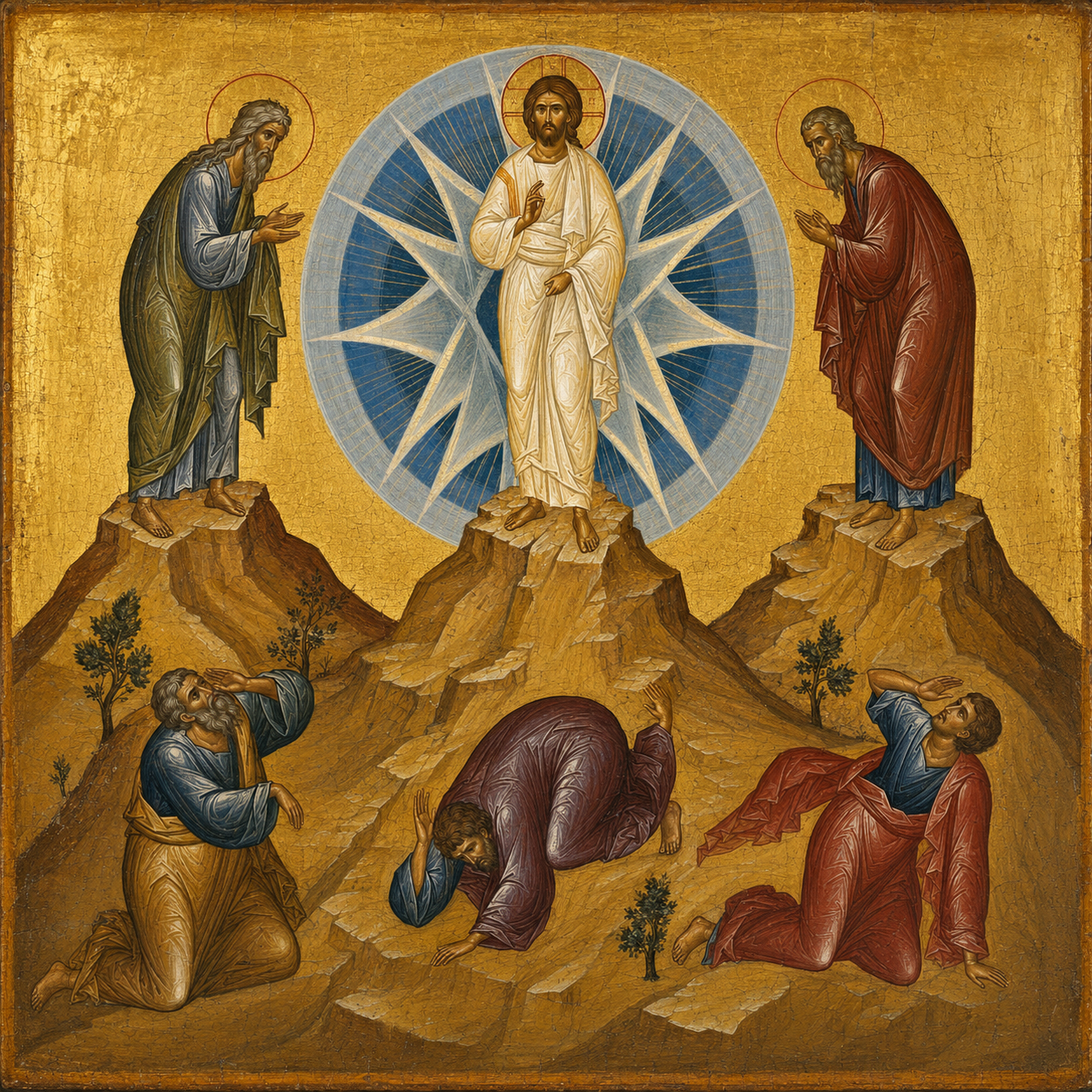
The Evangelist Matthew describes the great event of Christ’s Transfiguration as follows.
1 Jesus taketh Peter, James, and John his brother, and bringeth them up into an high mountain apart,
2 And was transfigured before them: and his face did shine as the sun, and his raiment was white as the light.
3 And, behold, there appeared unto them Moses and Elias talking with him.
4 Then answered Peter, and said unto Jesus, Lord, it is good for us to be here: if thou wilt, let us make here three tabernacles; one for thee, and one for Moses, and one for Elias.
5 While he yet spake, behold, a bright cloud overshadowed them: and behold a voice out of the cloud, which said, This is my beloved Son, in whom I am well pleased; hear ye him.
6 And when the disciples heard it, they fell on their face, and were sore afraid.
7 And Jesus came and touched them, and said, Arise, and be not afraid.
8 And when they had lifted up their eyes, they saw no man, save Jesus only.
9. And as they came down from the mountain, Jesus charged them, saying, Tell the vision to no man, until the Son of man be risen again from the dead (Matthew17:1-9).
Of the twelve disciples, Christ took only three with Him only to the summit—Peter, James, and John (Matthew 17:1). He chose these particular disciples because, at that time, they were the best prepared to behold the majesty of His glory.
There on the mountain, at the time of the Lord’s Transfiguration, Moses appeared, who had encountered the Lord on Mount Sinai (Exodus 19:3). Elijah also appeared, who had likewise encountered the Lord on Mount Horeb (3 Kings 19:8). At that glorious moment, they spoke with Christ about His Passion and death. This teaches us to remain mindful of death, especially during the brightest moments of our lives.
Did the Transfiguration of Christ take place during the day or at night?
The Evangelists do not answer this question. If we consider that the disciples had fallen into a deep sleep (Luke 9:32), we might conclude that the Transfiguration took place at night, while the Lord was praying (Luke 9:28). The Lord often prayed at night or very early in the morning (Matthew 14:23; Mark 1:35; Luke 6:12).
And at what time of year did the Transfiguration take place? How close was it to His Passion?
The prevailing view is that it took place forty days before His Passion and that, for this reason, the Church celebrates the Transfiguration on August 6, forty days before the Feast of the Exaltation of the Cross on September 14. However, this view does not appear to be correct.
Shortly before the Transfiguration, the Lord was in the region of Caesarea Philippi (Matthew 16:13). If we carefully examine the sequence of events, we will see that He appears to have been in Caesarea around August, during the final year of His public ministry. It was at this time that He was transfigured. Afterwards, He went to Galilee and then to Jerusalem (John 7:1, 14). Shortly before His Passion, He was in the region of the Jordan (John 10:22, 41; 11:54). Accordingly, our Church celebrates the Transfiguration in August because the event itself may have taken place during that month.
It was then that Peter said to the Lord, “You are the Christ, the Son of the living God” (Matthew 16:16). From that time onward, the Lord began to tell His disciples about His Passion (Matthew 16:21). In order to show them that He was God and that He was going to be crucified, He was transfigured before them, revealing His divine identity.
“His face shone like the sun” (Matthew 17:2). And all this may have happened at night!
Imagine such a sight appearing in the heart of the night.
Imagine if He had appeared to the world in this form throughout the three years of His public ministry, with His face always shining like the sun!
Who would have dared to approach Him? Everyone would have fallen down and worshipped Him as God. This was a revelation of His divine glory. Yet, out of compassion for human weakness, He humbled Himself. He concealed His divinity and majesty so that people might approach Him without fear.
“The Lord reigneth; He is clothed with majesty” (Psalm 93:1). Saint Isaac the Syrian interprets this verse from the Psalms as follows: “Humility is the raiment of the Godhead. The Word who became man clothed Himself in it” (Ascetical Homilies, Homily 77).
Jesus came to draw the world to Himself through His humility and simplicity, not through the majesty of His glory, before which both demons and human beings bow. He wished people to believe in Him freely and wholeheartedly, not under compulsion.
If you found this article helpful, feel free to share it with someone who may also benefit from it.
Leave a Reply