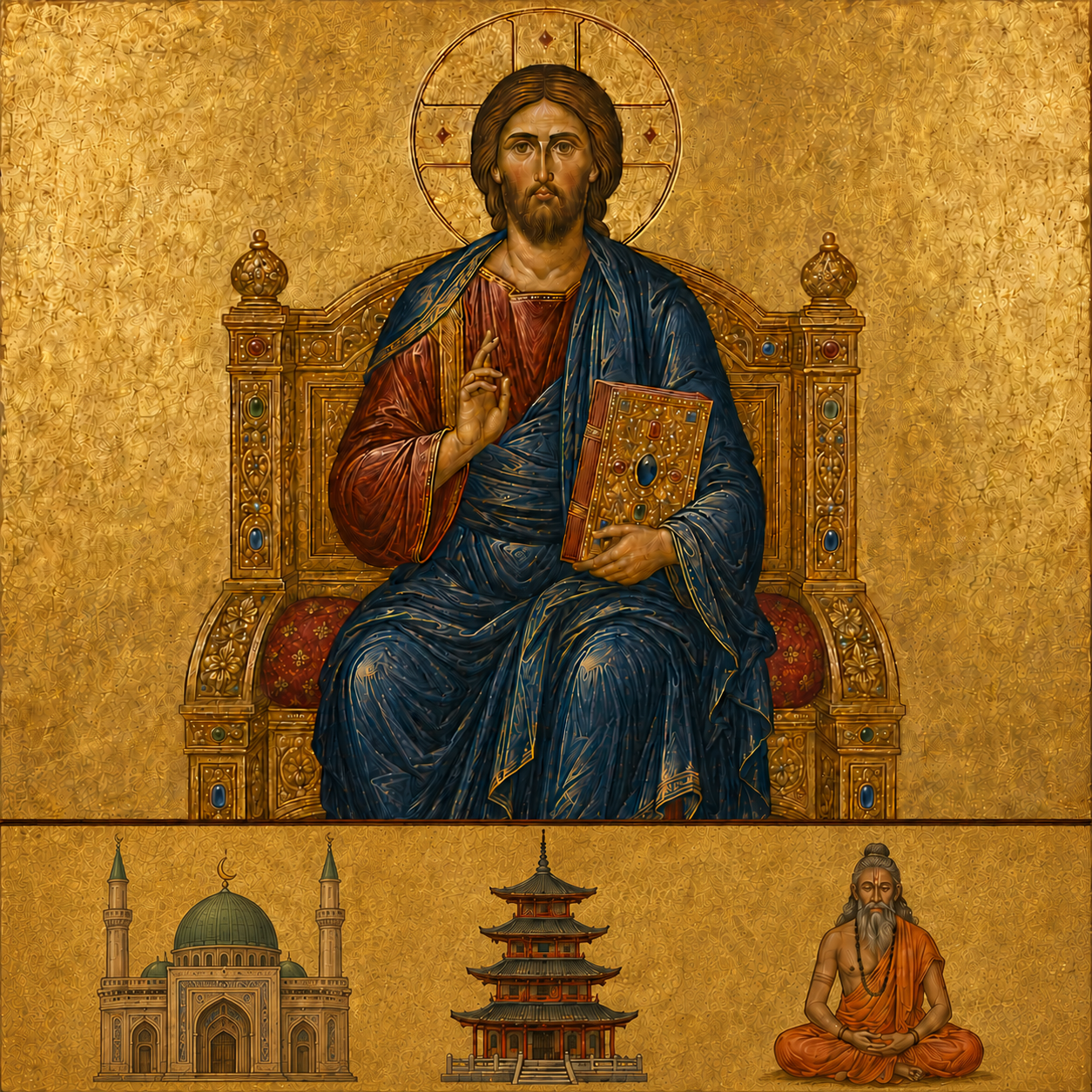
There are many religions, offering widely differing understandings of God. The question, however, is whether many gods can actually exist.
Saint John of Damascus, who lived during the seventh and eighth centuries, was one of the most distinguished figures of his time. Among other things, he was renowned for the depth of his theological and philosophical thought. He lived in the religiously diverse city of Damascus, where Islam held political power, while Christianity, Judaism, and other religious communities coexisted alongside it.
This situation compelled him to demonstrate that many gods cannot exist simultaneously. His explanation is genuinely compelling and leaves little room for doubt. Let us consider it carefully.
The divine is perfect in every respect, in goodness, wisdom, power, and every other divine attribute.
If we believe that many gods exist, then we must necessarily be able to identify certain differences among them. If there are no differences, then there is only one God, not many.
If differences do exist, however, and if one supposedly divine being lacks a perfection possessed by another, then that being cannot be God, because God is perfect. Therefore, if any being is not perfect in goodness, power, wisdom, or any other respect, that being cannot be God.
In other words, if there is no difference among the supposed gods, and if they possess one essence, one power, and one will, then we are speaking of one God, not many.
If there were many independent gods, the world would face a serious problem. How could it be governed by many gods, each possessing an independent will and purpose? Wherever independent wills exist, the possibility of disagreement and conflict also arises.
If someone were to argue that each god had been assigned a particular role in governing the world, the question would still remain: Who established this order and determined the role of each one? The being who possessed the authority to establish such an order would be superior to all the others and would, therefore, be the true God.
The conclusion, then, is that there is one God, perfect and beyond description, the Creator and Ruler of the universe. Everything begins from one source, from one first principle. (Saint John of Damascus, An Exact Exposition of the Orthodox Faith, Book I, Chapter 5, “Proof That God Is One and Not Many,” Patrologia Graeca 94:801. Adapted.)
The essential thing, therefore, is not merely to believe in a god, but to believe in the true God. Imagine believing in a god who does not exist, or in a god whom one does not truly know. Thus, the crucial question is this: Who is the one true God?
As Christians, we believe that the one true God has revealed Himself to us in Jesus Christ. Three distinctive features set Christ apart from the “gods” of other religions and make Christianity unique.
First, although He is the Son of God the Father, He became human like us for our sake. Is there anyone else who has humbled himself so greatly for the sake of humankind?
Second, He suffered, was crucified, and died for us. Is there anyone else who has made a comparable sacrifice for humankind?
Third, He rose from the dead by His own power. Note that Lazarus did not rise by his own power. Can we truly comprehend Christ’s Resurrection? He died as a man. His body was laid in the tomb, and the tomb was sealed with a large stone. Yet Christ, being God, brought His own body back to life and rose from the dead. Is there anyone else who has died and risen from the dead by his own power?
Therefore, in light of all the above, is Christ not worthy of being acknowledged as our true God?
“Oh, what wonderful things your religion teaches!” said a Hindu to a Christian priest.
For the first time in his life, the Hindu heard that God had become man for the sake of humankind. For the first time, he heard that God had been crucified, had died for humanity, and had risen from the dead.
We Christians have become accustomed to these truths, and so we often fail to appreciate their incomparable greatness. Familiarity dulls our sense of wonder.
Yet a true relationship with Christ, established through the keeping of His commandments, is always a relationship of light, life, and resurrection.
If you found this article helpful, feel free to share it with someone who may also benefit from it.
- Next in this series: How Can a Crucified God Save the World?
Leave a Reply