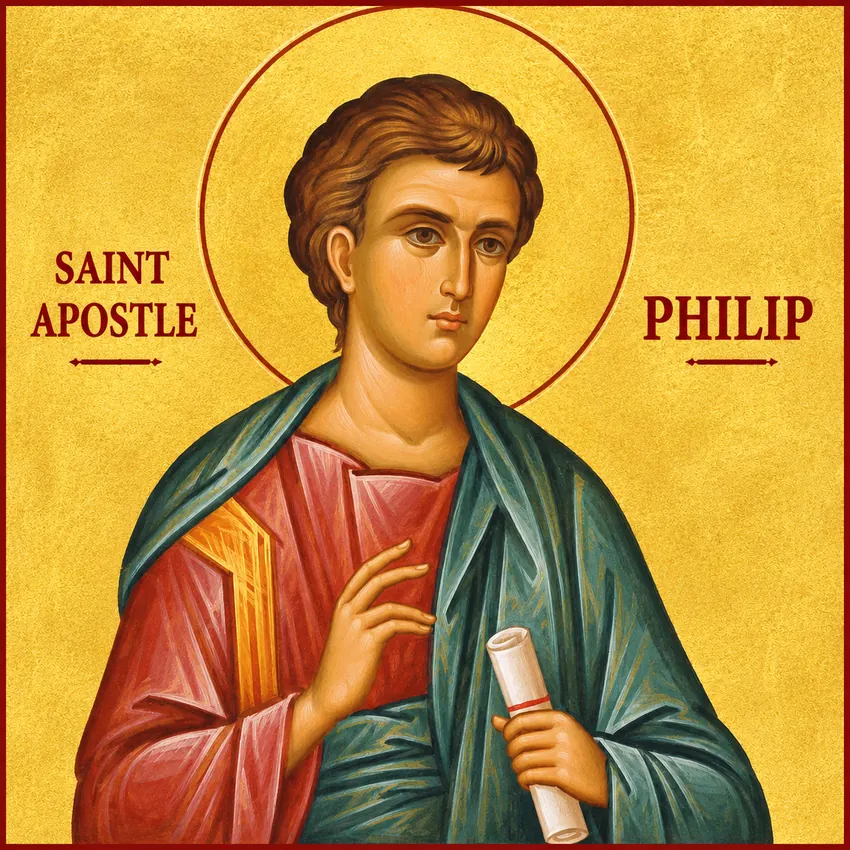
From the day following the commemoration of the Holy, Glorious, and All Praised Apostle Philip (November 14), that is, from November 15 until December 24, Christmas Eve, the Orthodox Church observes a period of fasting. It is important to examine how this fast developed and eventually became established within our Church. Its history was not without difficulties and controversies.
Initially, the Nativity Fast lasted seven days for Christians living in the world. But why seven days? By the seventh and eighth centuries, the custom had already become established among Christians of fasting for seven days before receiving Holy Communion. Since many Christians received Holy Communion on Christmas Day, a seven day fast before Christmas had become customary, “evidently as a spiritual preparation for Holy Communion,” as Professor of Ecclesiastical History Vlasios Pheidas points out (Ecclesiastical History, Vol. I, pp. 962–963).
In monasteries, however, this particular fast lasted forty days. Monks were permitted to eat fish on all days except the fasting days of Monday, Wednesday, and Friday (Saint Theodore the Studite, Chronological Instruction of the Monastery of Stoudios, P.G. 99:1696).
Under the influence of monasticism, the forty day Nativity Fast, which was already observed in monasteries, gradually began to spread among Christians living in the world. By approximately the eleventh century, it had become firmly established. In other words, the period of fasting before Christmas had been extended to forty days for lay Christians as well.
However, this extension of the fasting period provoked opposition from Christians who were attached to bodily pleasures, causing problems, confusion, and division among the faithful (Religious Controversy in Eleventh and Twelfth Century Byzantium: https://austriaca.at/0xc1aa5572%200x003ee0d5.pdf?utm_source=chatgpt.com).
During the patriarchate of Ecumenical Patriarch Luke Chrysoberges (1157–1169), a Local Council was convened in Constantinople in the presence of Emperor Manuel I Komnenos (1143–1180). The Council approved and endorsed the forty day fast that was already being observed within the Church.
The Council based its decision on the following significant statement by Patriarch Luke Chrysoberges:
“Since there are no written testimonies concerning the Nativity Fast, we must follow the unwritten tradition of the Church and observe the fast from November 14.”
The Patriarch also pointed out that the same principle applied to the fasts of the Most Holy Theotokos and the Holy Apostles (G. Rhalles and M. Potles, Syntagma, Vol. IV, pp. 419–420).
The Nativity Fast is less strict than the fast of Great Lent. Fish is permitted on all days except Wednesdays and Fridays.
It is noteworthy that, according to tradition, the period during which fish may be consumed begins on November 21, the Feast of the Entrance of the Most Holy Theotokos into the Temple, and ends on December 17, the feast day of Saint Dionysios. In other words, it begins seven days after the commencement of the fast and ends seven days before its conclusion.
The reason for this was that most Christians received Holy Communion on the feasts of the Entrance of the Theotokos and the Nativity of Christ, and therefore abstained from eating fish for seven days beforehand.
May you have a blessed Nativity Fast!
Leave a Reply