
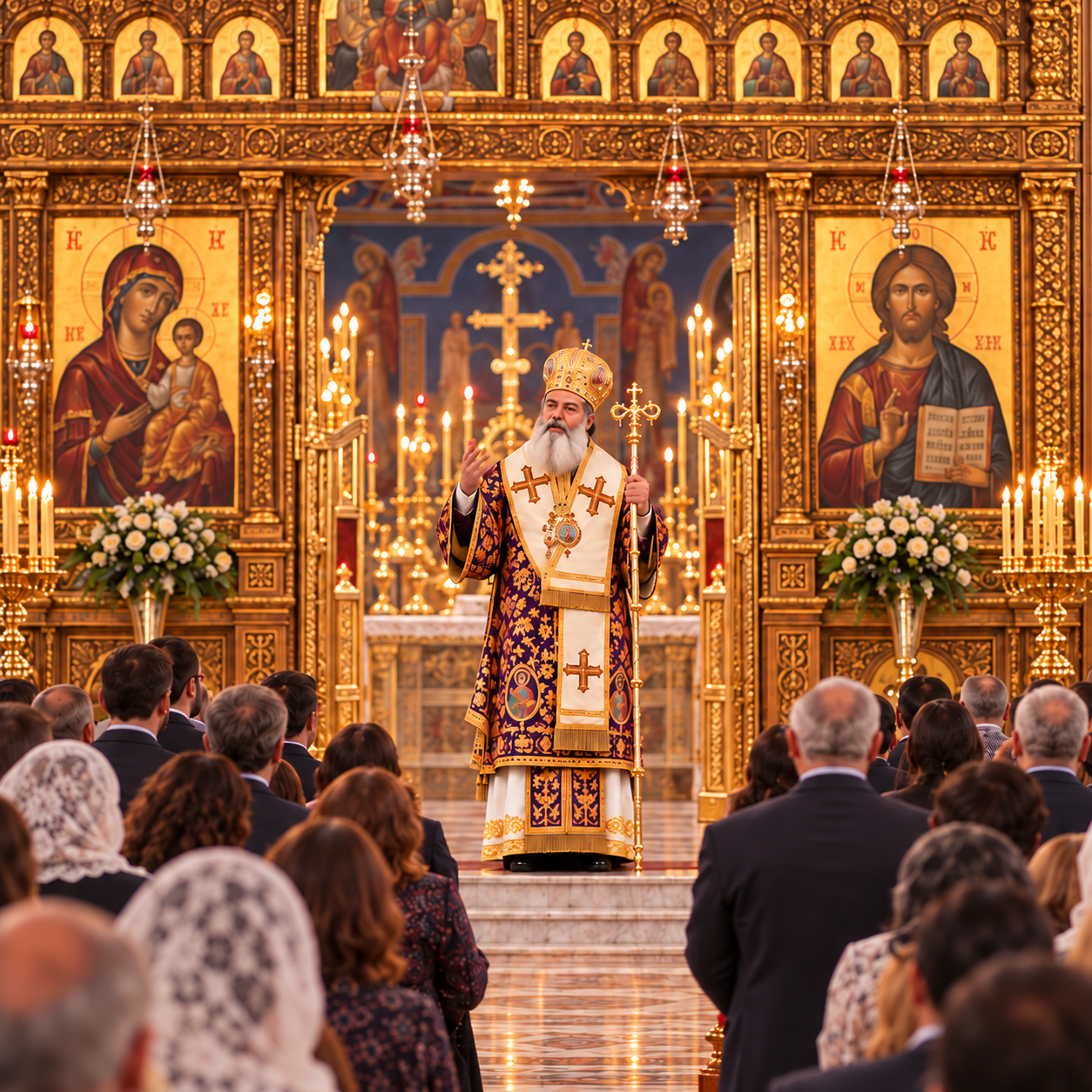
In recent times, the office of auxiliary bishop has been introduced into the Orthodox Church. But is this office consistent with the sacred canons?
Let us examine the question.
From the beginning, the Church recognised one bishop in each diocese. And when a bishop resigned, he lost not only his administrative authority but also the honours associated with his office. He was no longer even called a bishop. He was effectively reduced to the position of a presbyter.
Thus, when Eustathius, Bishop of Pamphylia, resigned from his duties in 430, he could not bear this loss of status. And the folowing year (431) he went in tears to nearby Ephesus, where the Third Ecumenical Council was being held (431), and pleaded with the Holy Fathers to allow him to retain the honour of being a bishop. They granted his request. (Letter of the Third Ecumenical Council to the local Synod of Pamphylia concerning Eustathius, in G. Rallis and M. Potlis, Collection of the Divine and Sacred Canons, vol. II, p. 206.)
This episode also illustrates another point. The widespread belief that a bishop is married to his diocese and can leave it only through death is inconsistent with the Church’s canonical order. (The same image, after all, is also applied to a priest and his parish…). In other words, when a bishop can no longer fulfil his duties, he submits his resignation, as Eustathius did: “He shall voluntarily resign from his episcopal office.” (Canon 16 of the First-Second Synod.)
How will he administer an entire diocese when his health does not permit it? After all, a priest, although he does not administer an entire diocese, resigns from his parish duties when circumstances warrant it. And rightly so. This gives him the opportunity, as an Elder used to say, to tend to his soul, away from the “noise.
It is said that when the health of Georgios Gennimatas, Minister of National Economy (Greece), deteriorated, he asked the then Prime Minister, K. Simitis, to allow him to resign from his ministerial post. And what did he say to the Prime Minister? “I want to resign so that I can devote myself to the salvation of my soul!” The Prime Minister suggested that he remain minister in name, and he remained until his death on 25 April 1994.
In our Church, bishops rarely resign, even when there are grounds for doing so. Instead, the institution of the auxiliary bishop has been devised. However, this arrangement is contrary to the canons. The objections extend beyond the prohibition against having two bishops in the same city. “There shall not be two bishops in the same city.” (Canon 8 of the First Ecumenical Council).
The rite of episcopal ordination presupposes that the person being ordained will be entrusted with a flock and with administrative authority. It is precisely to assume these responsibilities that he is ordained a bishop; otherwise, there is no reason for his episcopal ordination. An auxiliary bishop, however, is entrusted with neither a flock of his own nor authority of his own.
John Zonaras, in his commentary on Canon 57 of the Council of Laodicea, writes: “It dishonours God and the episcopal office for a bishop to preside over so small a flock.” If this is true, how much more does it apply to an auxiliary bishop who has no flock of his own at all? (The bishop is referred to as a Metropolitan, while his assistant is called an Auxiliary Bishop…).
And what should be done? Auxiliary Bishops should be elevated to the rank of “Chorepiscopi”; that is, they should be entrusted with administering a part of the Metropolis, so that they have their own flock and authority. If there is humility and love for the Church, this can be done. And if there is no love or humility, what kind of Church are we?
Leave a Reply