Heresies have always arisen within Christianity. They continue to arise today, and there are a great many of them. They are well known. There is no need to name or list them. But how and why do heresies arise? What happens along the way?
Let us take a closer look.
“Grandfather, we have lost that one!” a little demon said to the old devil, seeing a man who had discovered a fragment of truth. And the old devil replied, “We have not lost him. We have gained him. It is the whole truth you should fear!”
We must be careful! Every error contains a fragment of truth. There is a danger that we may become attached to the fragment of truth we see within an error and accept the entire “package,” under the illusion that we have found the truth. We then regard those who do not follow us as being in error.
It is on this basis, on the fragment of truth contained in every error, that heresies have arisen within Christianity. Indeed, some of them are laughable. Here is an example.
Have we heard, for instance, of the heresy of the Aristori? (Leftists). Canon 7 of the Ecumenical Council mentions it among other heresies: “Arians, Macedonians, Sabbatians, Novatians or Aristori…”
Consider this: that particular heresy concerned the left hand. Its followers were described as “abhorring the left hand and refusing to receive anything with it.” (G. Rallis and M. Potlis, Collection of the Divine and Sacred Canons, Volume II, Commentary on Canon 7 of the Holy Second Ecumenical Council.)
Apparently, it arose from the words of the Gospel: “Then He will say to those on His left, ‘Depart from Me, you who are cursed’” (Matthew 25:41). They stretched the meaning of these words and applied them to the left hand.
The words “He will say to those on His left” are true, but they have nothing to do with the left hand. Yet these people see a connection and consider it logical. After all, they base their belief on the words of Christ! To those of us who do not belong to this heresy, however, it seems ridiculous and irrational.
Saint Anthony the Great declares, “I saw all the snares of the devil spread out over the earth, and I sighed.” Why did he sigh? He saw errors, fragments of truth, and snares where he least expected them, in places that had never even crossed his mind, and that naturally do not cross our minds either. Saint Anthony continues, “And I said, ‘Who, then, can pass through them without being caught?’ And I heard a voice saying to me, ‘Humility.’” (Sayings of the Desert Fathers, Abba Anthony, Saying 7.)
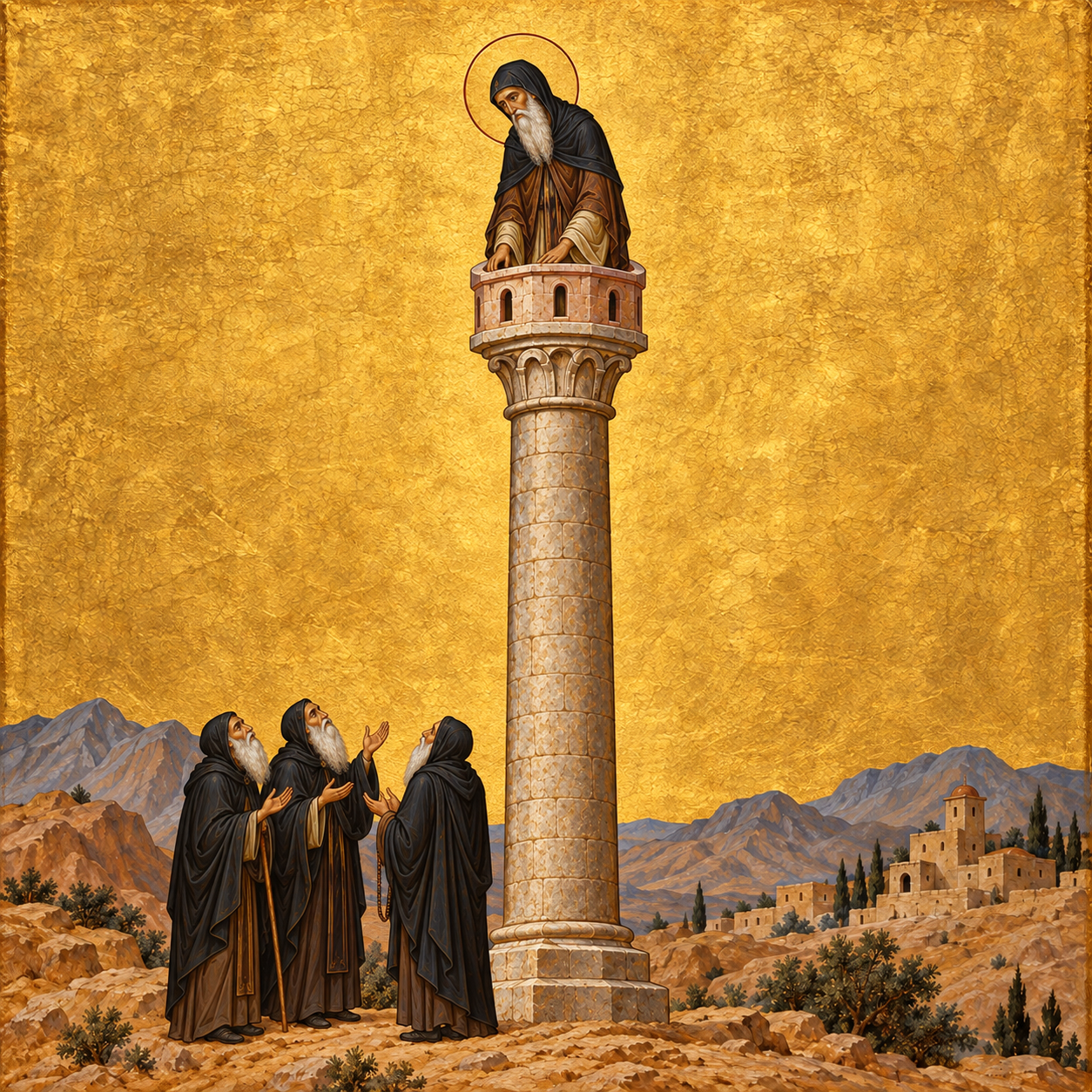
Here is another example. Saint Symeon the Stylite, who lived in the fourth century, was the first to introduce the ascetic practice of living on a pillar. The Fathers were troubled. They wondered whether what Symeon was doing came from the evil one or from God.
They decided to put him to the test. They went to him and said, “We disagree with this form of ascetic practice, and we ask you to stop and come down from the pillar.”
The saint replied, “Thank you. I will come down immediately.”
They answered, “No, do not come down. We were testing you. If you had refused to come down, we would have brought you down by force, because that would have been a sign that your ascetic practice came from the evil one. It would have contained pride, and you would not have listened to us. But since you agreed to come down, this shows that your choice was marked by humility and was therefore not a delusion.” (Great Synaxarion of the Orthodox Church, Volume IX, Life of Saint Symeon the Stylite, September 1.)
Saint Symeon possessed humility. He did not place his trust in his own thoughts or reasoning. That is why he obeyed!
It is no coincidence that the Lord began His famous Sermon on the Mount (Matthew, chapters 5, 6, 7, and 8:1 to 23) with the renowned Beatitudes, the first of which praises humility: “Blessed are the poor in spirit, for theirs is the Kingdom of Heaven” (Matthew 5:2). To be poor in spirit is to be humble in heart. And as long as humility is lacking, heresies will continue to arise.
Next in this series: Bible and Heresies. How Biblical Interpretations Lead to Heresy.
Leave a Reply