Shortly before the end of His earthly life, Christ said, “If they persecuted Me, they will also persecute you” (John 15:20). The three years of Christ’s public ministry were marked by persecution.
A proverb asks, “Who has ever seen a son on the cross and his mother at the table?” Who has ever seen a son suffering while his mother eats and drinks? Whenever Christ was persecuted, it was as though His Mother herself were being persecuted. Christ’s pain and agony were also the pain and agony of His Mother.The culmination of her suffering was the Crucifixion of her Son.
- On Friday morning, she went to Golgotha to witness the death of her Son. While Jesus was hanging on the Cross, He said to her, “Woman, behold your son!” (In Aramaic, the word “woman” conveyed greater respect than the word “mother.” It meant, “My respected lady!” When children wished to express their respect for their mother, they addressed her as “woman.”) Then Jesus said to John, “Behold your mother!” From that hour, the disciple took her into his own home (John 19:26–27). Despite His unbearable pain, Christ cared for His Mother’s future.
Joseph and Nicodemus removed His body from the Cross and buried Him (John 19:38–42). The Virgin Mary remained near Jesus’ burial place (Matthew 27:61).
According to tradition, a grieving woman approached Mary and told her of her own tragedy: her son had committed suicide. This woman was the mother of Judas Iscariot, and she asked Mary to forgive both her and her son. Mary responded, “My Son taught us to love and forgive; therefore, I love you and forgive both you and your son.”
Her lamentation
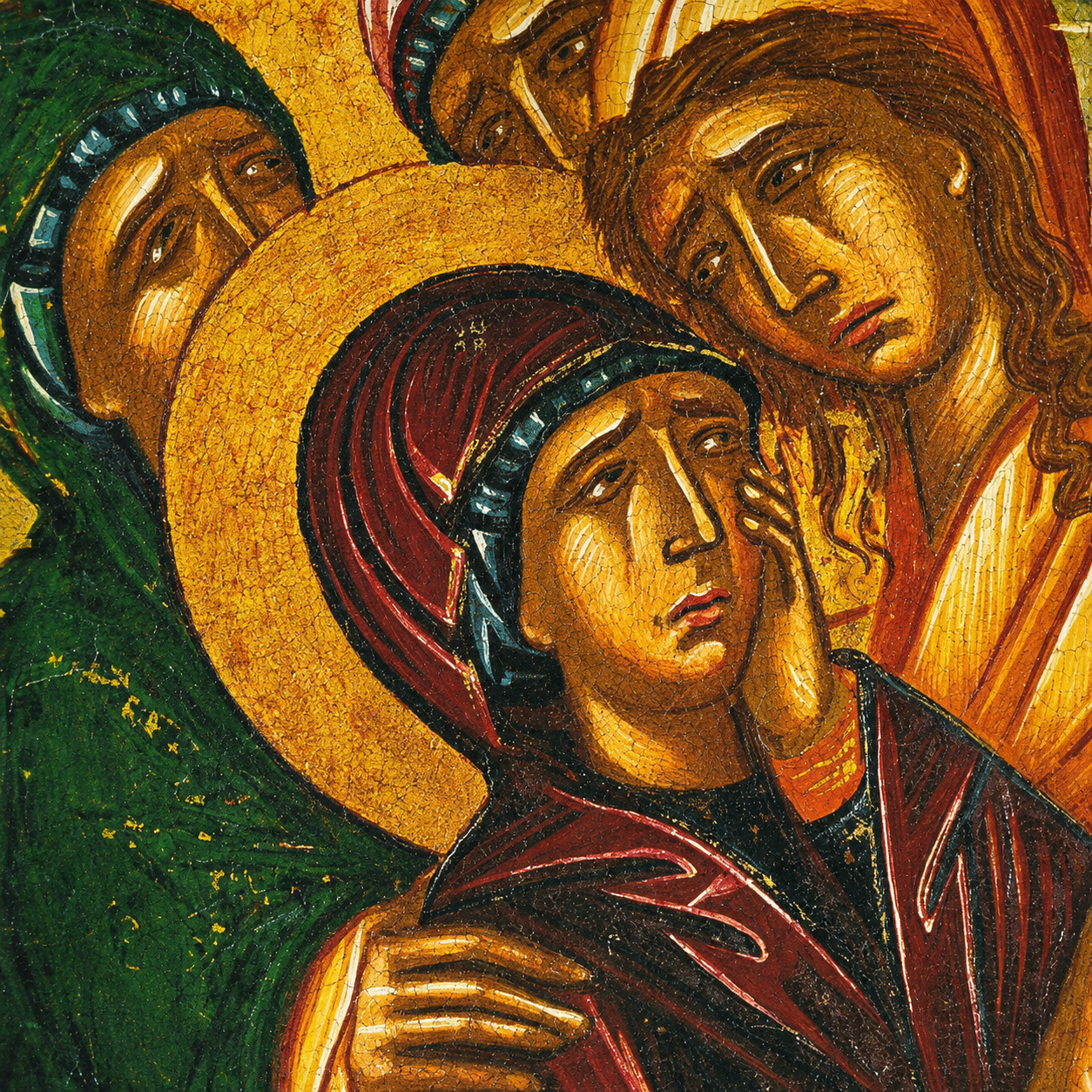
If any mother mourns the dreadful death of her son, how much more deeply did Mary mourn, she who was the “source of compassion”? As she followed her Son to Golgotha, she was “beating her breast in profound sorrow” (cf. Luke 23:27). The well-known tradition of the Monastery of the Great Virgin is associated with this moment of the Virgin Mary’s suffering at the foot of the Cross.
She saw with her own eyes her Child being crucified. Christ suffered upon the Cross, and His Mother suffered with Him. Every nail that pierced her Son’s body also pierced the Virgin Mary’s soul. Her heart was tormented as she witnessed the Passion of Jesus Christ: “Of all womankind, I alone bore You, my Child, without pain; but now cruel pangs overwhelm me as I behold Your great suffering.” (Matins of Holy Saturday, Lamentations, Second Stasis).
Saint Silouan the Athonite teaches that the Virgin Mary “remained alive only because the Lord’s might sustained her… so that she might behold His Resurrection” (Archimandrite Sophrony, Saint Silouan the Athonite, SVS Press, 1999, Part II, Chapter IX, “On the Mother of God,” p. 390). In other words, the Virgin Mary did not die on the spot as she watched her only Child being nailed to the Cross. She endured through the strength granted to her by her crucified Son and God so that she might later behold and experience the joy of His Resurrection.
If you found this article helpful, feel free to share it with someone who may also benefit from it.
Next in this series: The Life of the Theotokos After the Ascension of Jesus
Leave a Reply