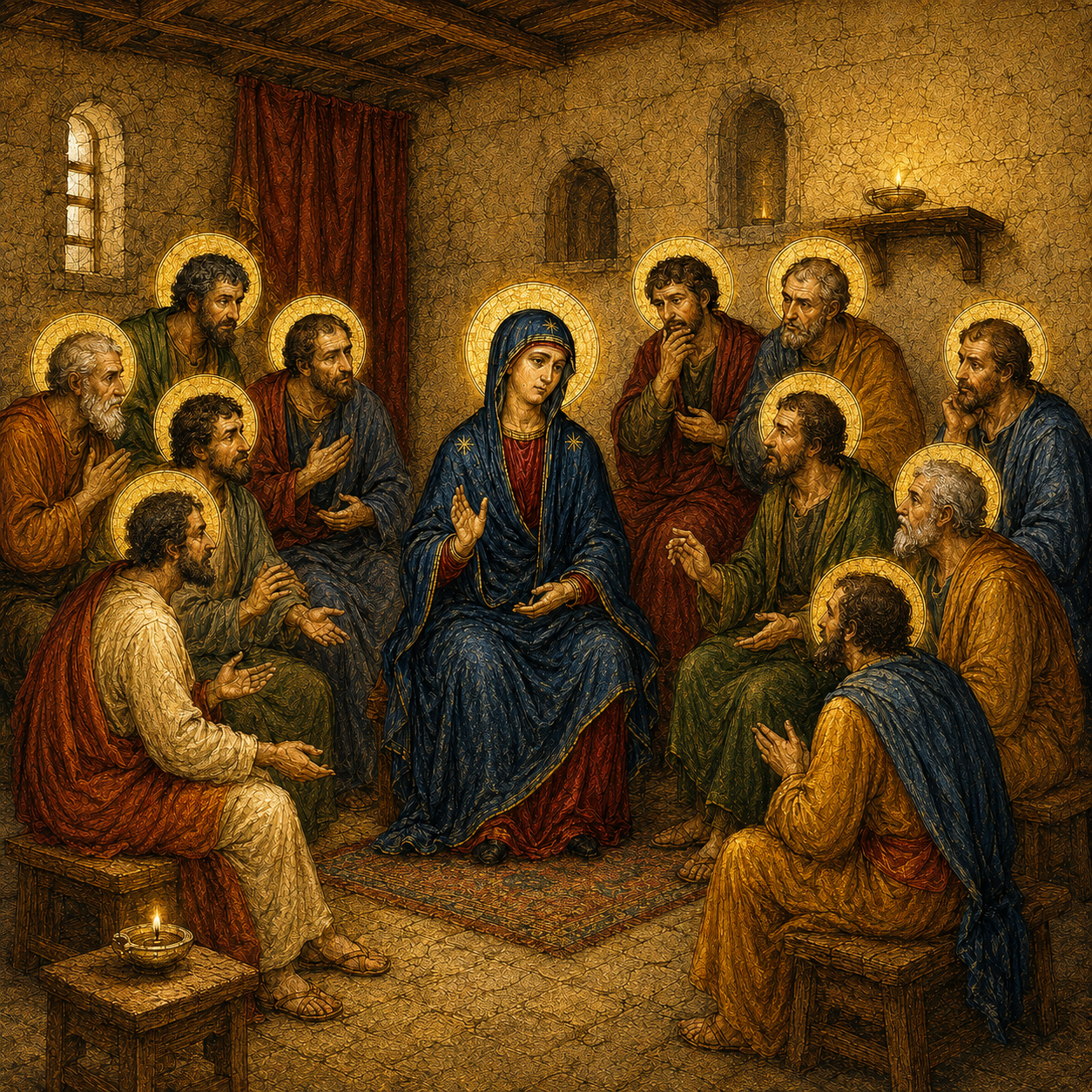
Mariam stayed with John in the Upper Room in Jerusalem. She spent her nights praying to her Son. Her prayers were accompanied by reverent bodily acts, such as kneeling and prostrations (metanoies), as she worshipped her Son throughout the night. Prolonged kneeling caused swellings resembling eggs to form on her knees. Indeed, resting her knees on the ground for so long even left an indentation in the stone beneath her! (Saint Andrew of Crete, Homily XII on the Dormition, PG 97:1057, and Homily XIII, PG 97:1073).
At daybreak, she would lie down for a short while on a bed of stones (Epiphanius the Monk and Priest, Homily on the Theotokos, PG 120:209, 212).
As the Mother of Christ, she was a central figure in the Christian community and among the Apostles themselves. They sought her counsel concerning their preaching. In fact, the Apostles arranged to gather once a year to celebrate the Resurrection of Jesus with the Lord’s Mother.
The Persecution of the Theotokos
Following the execution of the first martyr, Stephen, certain Jewish opponents of the early Church began severely persecuting Christians. St. Luke the Evangelist informs us: “At that time a great persecution arose against the church which was at Jerusalem” (Acts 8:1).
Mariam lived in the midst of this hostile environment. As the Mother of Jesus, she became a particular target. They taunted, mocked, and slandered her. On many occasions, they gathered outside her house, ready to throw stones and intimidate her. But her Son intervened through his invisible power and drove them away. They repeatedly returned, determined to continue their evil actions, until one day they finally learned their lesson.
These wicked people decided to demolish Mariam’s holy home using stones, crowbars, pickaxes, and flaming torches. After surrounding the house, they began their assault, shouting angrily. Yet they were utterly humiliated. The crowbars and pickaxes broke as though they were made of paper. The stones hurled at the door rebounded and struck them instead. The same thing happened with the flaming torches. The flames changed direction and burned their faces. They fled from the house without having caused the slightest damage.
Despite this humiliation, they did not stop taunting and mocking the Mother of the Lord. They did not even respect her funeral, but there, too, they learned their lesson.
From the book The Life of Our Blessed and Glorious Lady, the Theotokos and Ever Virgin Mary, by Saint Maximos the Confessor.
If you found this article helpful, feel free to share it with someone who may also benefit from it.
Next in this series: Why Did the Theotokos Die?
Leave a Reply