Because Christ is her Son, the Theotokos can approach Him with a mother’s boldness and even express her objections. And indeed, she does! Here is an example.
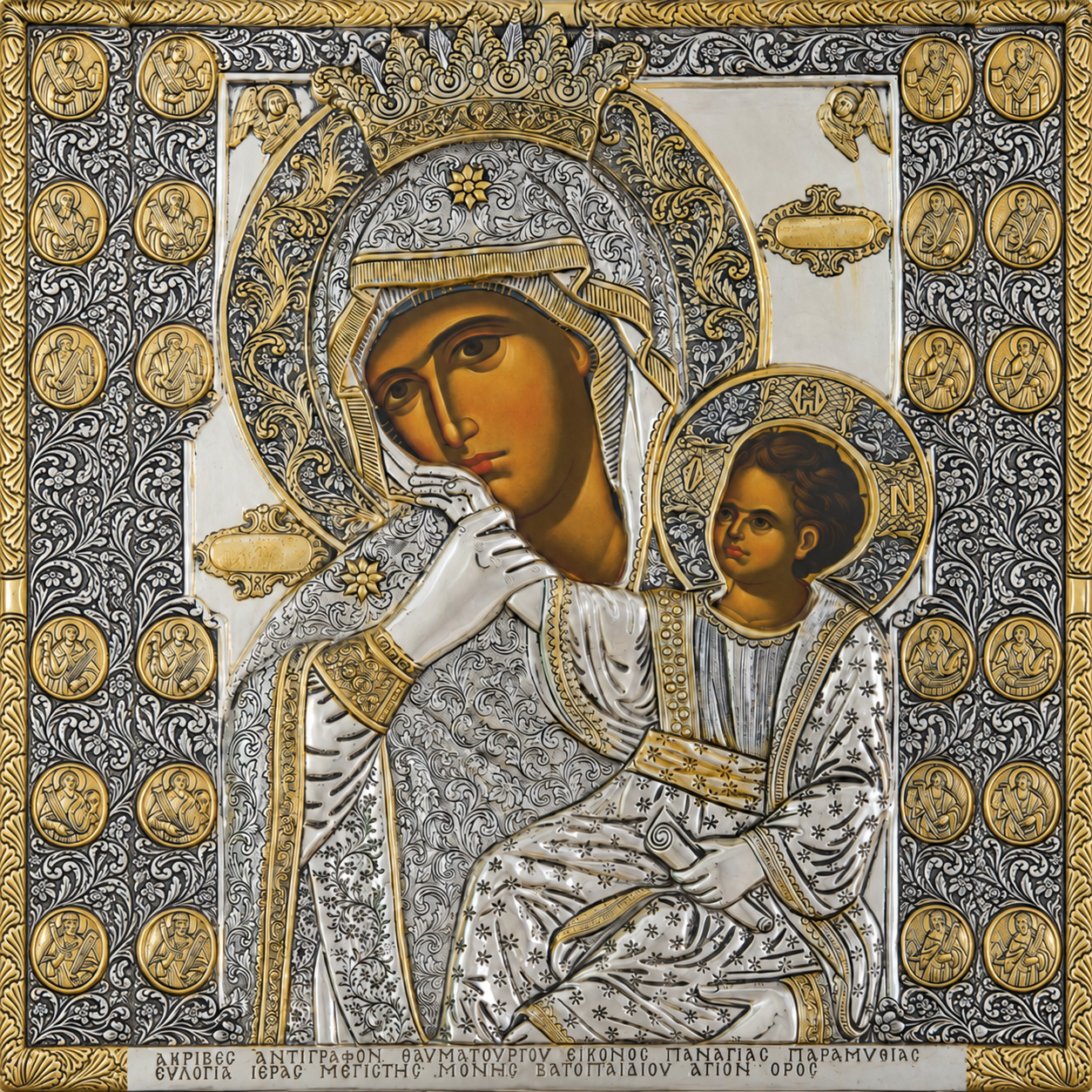
At the Holy Monastery of Vatopedi, there is a fourteenth-century fresco icon of the Mother of God known as “Panagia Paramythia,” or “Our Lady of Consolation.”In earlier times, as soon as the service of Matins had ended, the monks would venerate the icon, and the Abbot would hand the keys of the Monastery to the gatekeeper.
One morning, after Matins had ended, as the Abbot was handing the keys to the gatekeeper, he heard a voice coming from the icon, saying: “Do not open the gates today. Go up onto the walls and drive away the pirates.” The voice was heard a second time. The Abbot looked toward the icon and saw the Christ Child stretch out His hand, cover His Mother’s mouth, and say to her: “Mother, do not concern yourself with these sinners. Let them be punished as they deserve.”
However, the Mother of God took Christ’s hand away from her mouth, turned her head toward the Abbot, and said once again: “Do not open the gates today. Go up onto the walls and drive away the pirates.” (This can also be seen in the icon accompanying this article.) The monks quickly climbed onto the walls and saw the pirates outside the Monastery, waiting for the gates to be opened so that they could enter.
What does this mean? Did the Theotokos desire the good of the monks, while Christ desired their destruction? Of course not.
Both Christ and His Mother desired the salvation of the monks.
The Theotokos sought to lead them to repentance. By seeing the danger posed by the robbers, the monks would be awakened and brought to repentance. Christ sought their repentance through their violent death, in accordance with His words: “Unless you repent, you will all likewise perish” (Luke 13:3, 5), showing that a tragic death may serve in place of repentance. In the end, the merciful intercession of the Mother of God prevailed. And this was not the first time.
Let us remember that Christ and His Mother were present at the Wedding at Cana. The wine had run out, but the wedding celebration was already drawing to a close. Therefore, there was no urgent need for more wine. Christ had intended to begin performing His miracles at a later time (John 2:4). Yet, when His Mother said to Him, “They have no wine,” He performed His first miracle then and there out of regard for her, turning water into wine (John 2:1–11).
Let us consider how willing the Lord is to listen to His Mother when she intercedes in matters of true importance.
The contemporary Romanian saint Cleopa Ilie said, in effect: Because of humanity’s sins, Christ would have already destroyed the world, but He is restrained by His Mother. Just as she gave birth to Him and wrapped Him in swaddling clothes, so now, through her intercessions, she restrains His wrath so that the world may not be destroyed.“O protection of Christians that cannot be put to shame, unwavering intercessor before the Creator.”
If you found this article helpful, feel free to share it with someone who may also benefit from it.
Next in this series: Why Is the Icon of the Theotokos Called Hodegetria?
Leave a Reply