
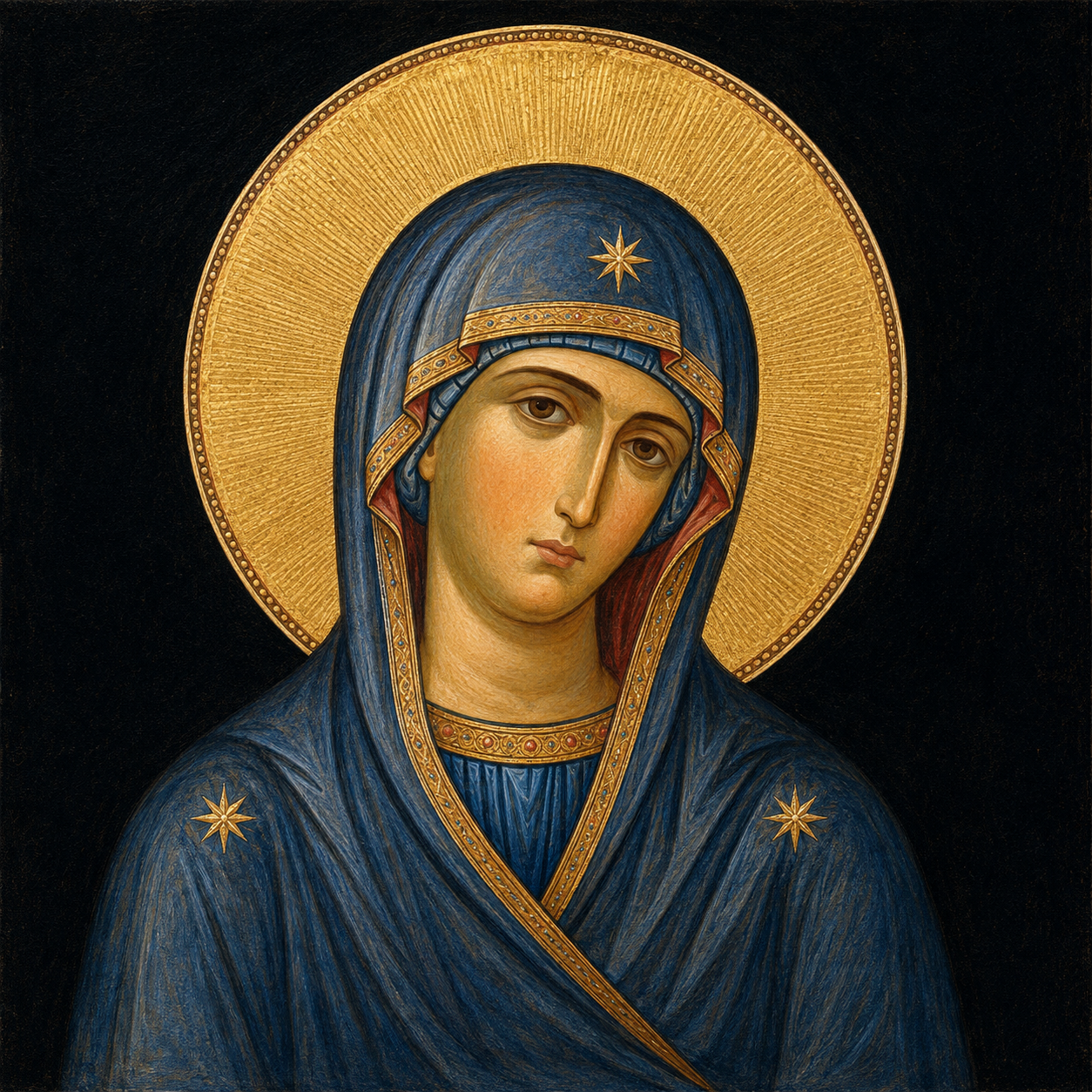
- Let us begin with a joke. A nun would kneel before an icon of the Virgin Mary and say to her, “You are a virgin, and so am I. You gave birth, but I did not,” implying that, as a virgin, the nun considered herself superior to Mary.
It is easier to preserve the virginity of the body than the virginity of the soul. The body may remain virginal while the soul is impure. The soul first commits fornication, and then the body follows. Thus, the greatness of Mary’s virginity lay not only in the fact that she was a virgin in body but also in the fact that she was a virgin in soul.
“After Mary had been planted in the house of God, by the grace of the Holy Spirit she became like a fruitful olive tree. She banished from her mind every worldly and carnal desire and preserved both her soul and her body in virginity” (Saint John of Damascus, On the Holy Theotokos, IV, PG 94:1160).
It was during the Annunciation that the inconceivable depth of her virginity became especially evident. She was alone at home when the Archangel Gabriel brought her the divine message that she would conceive and bear a Son (Luke 1:31). She knew that children were conceived through the union of a man and a woman (Luke 1:34), and standing before her was Gabriel, appearing as a young man.
Nothing stirred within her, in the depths of her soul, to arouse carnal desire as she stood before this beautiful young man. This was something that astonished the Archangel Gabriel: “Seeing the beauty of your virginity and the radiant splendor of your purity, Gabriel was amazed and cried out to you, O Theotokos: What worthy praise can I offer you? How shall I address you? I am at a loss and filled with wonder!”
In other words, Mary did not commit adultery even in thought; she perfectly observed the commandment of her Son, which forbids adultery even in one’s thoughts (Matthew 5:28). Indeed, if the Mother of Christ could not attain this purity, who could? The greatness of virginity is diminished when it is understood as something merely physical.
This kind of perfect virginity was her own spiritual accomplishment, the fruit of her constant inner vigilance.
Yet she also possessed another kind of virginity, a supernatural virginity that was purely a gift from God. She conceived without the seed of man, something unprecedented in the history of the world. And there is more: although she conceived and carried the infant Jesus within her for nine months, she gave birth without her virginity being impaired. She was both Mother and Virgin.
“Rejoice, you who brought opposites into harmony; rejoice, you who united virginity with childbirth” (Third Stanza of the Salutations to the Theotokos).
She brought together and united two apparent opposites: she was pregnant and yet a virgin, a mother and yet a virgin. She remained a virgin before, during, and after the Nativity. The three stars with which she is depicted in Orthodox iconography symbolize these three aspects of her virginity.
“All your mysteries, O Theotokos, are beyond comprehension and surpassingly glorious. Sealed in purity and preserved in virginity, you were revealed to be truly a Mother, giving birth to the true God. Entreat Him to save our souls” (Apolytikion in the Second Tone).
If you found this article helpful, feel free to share it with someone who may also benefit from it.
Next in this series: The Presentation of the Lord. Purification and Reverence.
Leave a Reply