
The Prophet David prophesied: “Listen, O daughter, consider and incline your ear; forget your people and your father’s house. Then the King will desire your beauty” (Psalm 45:10–11). David was referring to Mary, who entered the Temple and remained there, “preparing herself for the divine dwelling” (Menaion, November 21, Matins, First Canon of the Feast, Ode 1). Thus, the Orthodox Church connects the Entrance of the Theotokos into the Temple with the approaching Feast of the Nativity of Christ. The hymn “Christ is born; glorify Him!” begins to be chanted on the Feast of the Entrance, which is celebrated on November 21.
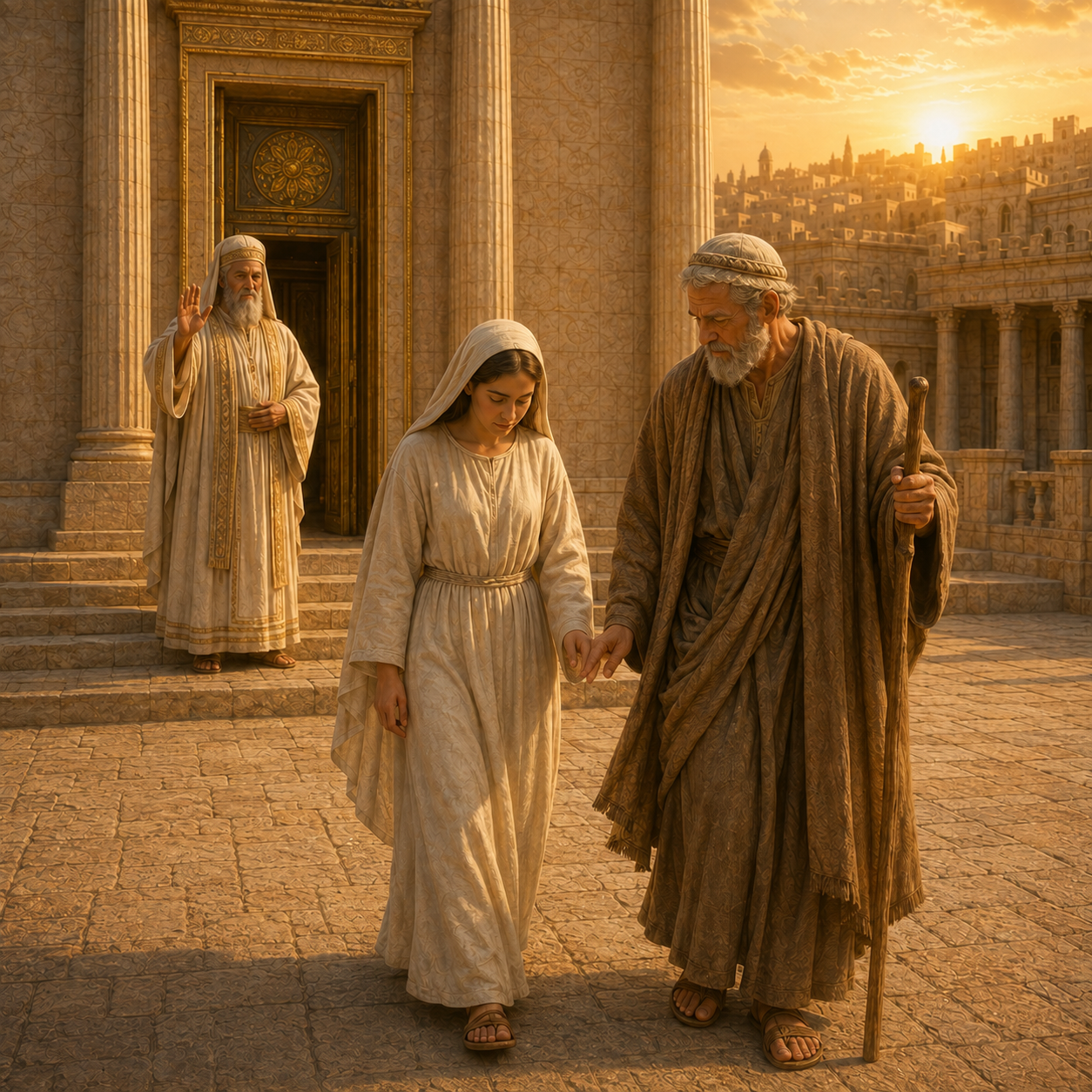
However, Mary could not remain in the Temple forever. At some point, she would have to leave, and that time had now come.
Twelve years had passed since Mary had entered the Temple, and she was now fifteen years old. Under the Mosaic Law, a menstruating woman was considered ritually, rather than morally, unclean (Leviticus 15:19–30) and was therefore not permitted to enter the Temple during menstruation.
Because of the natural and sinless bodily changes associated with puberty, the priests questioned whether it was appropriate for Mary to remain in the Temple (Saint John of Damascus, Homily I on the Dormition, PG 96:709). They therefore decided that the time had come for her to leave the Temple and enter the world. This decision, which was based on the ritual prescriptions of the Old Law, should also remind us how sacred the Temple of God is and with what purity of heart and reverence we should enter this holy place.
Mary, however, was an orphan. She had no siblings and had lived within the Temple precincts since early childhood. Where, then, and how could she live on her own? Moreover, as Saint John of Damascus explains, the devil knew from Isaiah’s prophecy that the Messiah would be born of a virgin (Isaiah 7:14) and therefore sought, by every possible means, to lead unmarried young women into sexual immorality. To conceal the mystery from the devil, the priests betrothed Mary to Joseph and entrusted her to his care, so that he might safeguard her virginity (An Exact Exposition of the Orthodox Faith, Book IV, “Concerning the Genealogy of Our Lord and the Holy Mother of God,” PG 94:1160; cf. Saint Theophylact of Bulgaria, On the Genealogy of Christ, PG 123:155).
To emphasize Joseph’s virtue and self-control, the Evangelist Matthew writes that Joseph “did not know her till she had brought forth her firstborn Son” (Matthew 1:25), meaning that Joseph never had marital relations with Mary. (Note that in Scripture, the word “till” does not necessarily imply that the situation changed afterward. For example, Michal, the daughter of Saul, “had no child to the day of her death” (2 Samuel 6:23). Does this mean that she bore a child after her death?)
It should also be noted that, at that time, a betrothed woman was regarded as a lawful wife (Matthew 1:20, 24). Thus, in the eyes of Jewish society, Joseph was considered Mary’s husband.
Furthermore, Mary was betrothed to Joseph so that the Jews would not regard Jesus as an illegitimate child, but as the son of her lawful husband. Consequently, Jesus was commonly believed to be Joseph’s son. This is evident from the words spoken by Philip to Nathanael: “We have found Him of whom Moses in the Law, and also the prophets, wrote, Jesus of Nazareth, the son of Joseph” (John 1:45).
If you found this article helpful, feel free to share it with someone who may also benefit from it.
Next in this series: The Annunciation of the Theotokos
Leave a Reply