
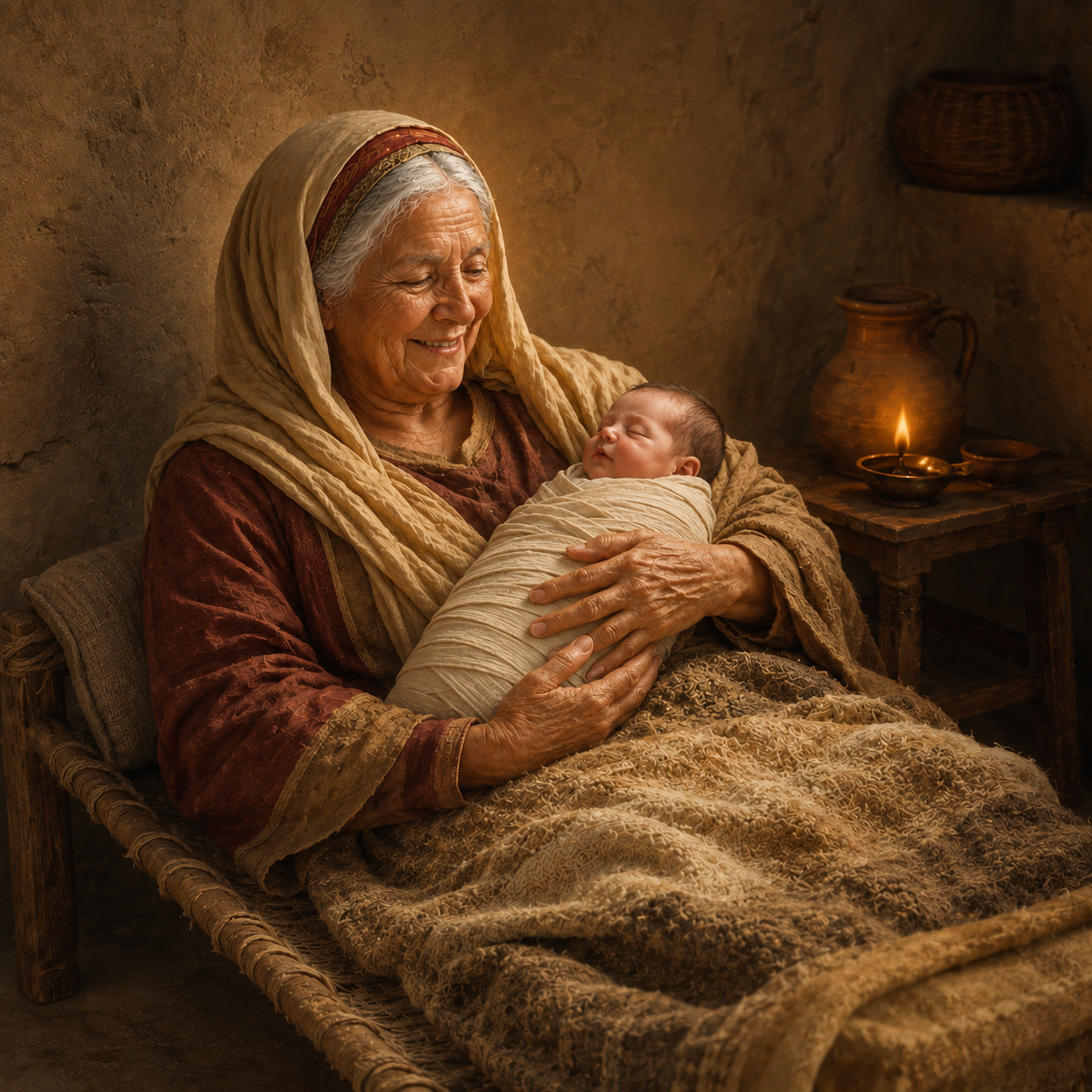
While Joachim and Anna were still praying in separate places, God heard their supplications. Their sorrow was about to be transformed into joy, for He sent His angels to announce that their prayer had been granted. This divine announcement is proclaimed in the hymnography of the Church:
“Of old, the chaste-minded Anna, entreating and beseeching God, heard an angelic voice announcing to her the divine fulfillment of her petitions. One of the incorporeal beings manifestly conversed with her, saying, ‘Your supplication has come before the Lord. Be not downcast, neither weep, for you shall be a fruitful olive tree, putting forth as a branch the comely Virgin, who shall bring forth in the flesh a flower, Christ, who grants great mercy to the world!’” (Menaion, December 9, Aposticha of Vespers).
“Everything you have asked for will be granted. You may now return home,” an angel told Joachim. Another angel told Anna, “You will give birth to a child who will be glorified throughout the earth.”
Anna waited for Joachim at the entrance to their home. When he arrived, she fell into his arms. “The Lord has blessed us. Glory be to God,” she said.
Anna conceived a child. In the Church’s liturgical calendar, the Conception of the Most Holy Theotokos by Saint Anna is commemorated on December 9: “On December 9, we celebrate Saint Anne’s Conception of the Most-Holy Theotokos” (Menaion, December 9, Synaxarion).
Nine months later, on September 8, the Church celebrates the Nativity of the Most Holy Theotokos. Anna gave birth to a beautiful baby girl. According to Jewish custom, the baby was washed with water and salt, to toughen her skin, and wrapped in swaddling clothes (cf. Ezekiel 16:4). Following another Jewish custom, her parents, Joachim and Anna, named her after one of their relatives (Luke 1:61). They called her Mariam (Luke 1:27), a name interpreted as meaning “lady” or “mistress of the house.” It was also the name of her grandmother, Anna’s mother, who was the wife of a priest. The Greek form of Mariam is Μαρία (Maria) (Matthew 1:16), rendered in English as Mary.
Thus, the reproach of childlessness endured by Joachim and Anna gave way to the honor and joy of becoming parents: “By your holy birth, O Immaculate One, Joachim and Anna were delivered from the reproach of childlessness” (Kontakion of the Feast of the Birth of the Virgin Mary).
Yet God did not bring this child into the world merely to remove the reproach of childlessness from Joachim and Anna. Rather, He brought her into the world to remove the reproach of the entire human race, the reproach brought upon humanity through the sin of our first parents, Adam and Eve: “Your people, redeemed from the guilt of sin” (Kontakion of the Feast).
“Your birth, O Theotokos, has proclaimed joy to the whole universe. The Sun of Righteousness, Christ our God, has shone from you, O Virgin. By annulling the curse, He bestowed a blessing. By destroying death, He has granted us eternal life.”
Anna placed Mary in a specially prepared room, which was filled with the sounds of religious hymns and prayers. Only young virgins were permitted to enter.
The baby grew and developed. When she reached six months of age, her mother eagerly waited to see her take her first steps. One day, Mary stood on her feet, took five or six steps, and ran into her mother’s arms. “No,” her mother told her. “From now on, you will not walk here again. You will take your first steps toward the Temple.”
When the baby girl turned one year old, her parents celebrated her first birthday. They invited the priests and the rulers of Jerusalem and prepared a formal banquet.
Anna took the baby girl from her private room and brought her before the priests so that they might bless her. Afterward, she returned Mary to her room.
Thus, from her earliest childhood, Mary was lovingly prepared for the unique calling that awaited her: to become the Mother of God and the living Temple of the incarnate Lord.
If you found this article helpful, feel free to share it with someone who may also benefit from it.
Νext in this series: The Entry of the Virgin Mary into the Temple
Leave a Reply