Symeon had made a vow to God—not to man—to become a monk. The way had now been opened for him to fulfill his vow. At that time, those who entered monastic life severed all ties with their former life.
The long-awaited moment had come for the twenty-four-year-old Symeon to bid his parents farewell forever. They would never see him again. In an atmosphere of deep emotion, his parents gave him their final kiss.
He was tonsured a monk and ordained a deacon (1510–1520 A.D.). He then took up residence at the Komnenion Monastery on the foothills of Mount Kissavos in Thessaly, Central Greece.
- A single cassock and bare feet
“Do not have two tunics apiece” (Luke 9:3). Symeon made this word a rule of life and practice. From the day of his monastic tonsure until the end of his life—approximately eighty-eight years—he never wore a second cassock. His only garment was the worn and patched cassock of his tonsure, which reminded him of the poverty of the soul.
At the same time, he went even further in ascetic practice. While Christ instructed His disciples not to wear shoes but sandals (Mark 6:9), Symeon never wore sandals at all. He traveled everywhere barefoot. On rocks and thorns his feet were wounded and bled. In winter, walking on snow and ice, his feet turned blue from the cold.
He became known as the monk who wore only a single cassock and went barefoot.
- On Mount Athos
In 1520 A.D., at the age of thirty-four, Symeon ascended to Mount Athos, where he remained for approximately five years (1520–1525), seeking to deepen his ascetic life.
His first stop was the Great Lavra Monastery, where he received the second degree of priesthood. He then moved to Philotheou Monastery.
At that time, the abbot’s seat was vacant, and the monks urged him to assume leadership of the monastery. He initially refused, but their persistent request led him to accept, interpreting this as the will of God.
However, the saying “all that glitters is not gold” proved true. Although the monks of Philotheou appeared devout, many were so only in appearance.
As abbot, Symeon immediately began to introduce a stricter ascetic discipline, but this did not please the monks. Their resentment gradually turned into open hostility.
Symeon was filled with sorrow—not because of what was done to him, but because the monks had fallen spiritually before God.
- He leaves Mount Athos
Distressed by these events, he left Mount Athos and returned to the outside world, settling on the slopes of Mount Pelion in Central Greece.
From an external perspective he descended, but spiritually he rose even higher. On Mount Athos he had his cell, his daily bread, and companionship. Now he chose a place where none of these comforts existed.
He settled on a remote mountainside northeast of Pelion, at an altitude of approximately one thousand meters, overlooking Mount Athos and the historic Bathyrema. The place was isolated and inaccessible, yet suitable for prayer and deep spiritual contemplation.
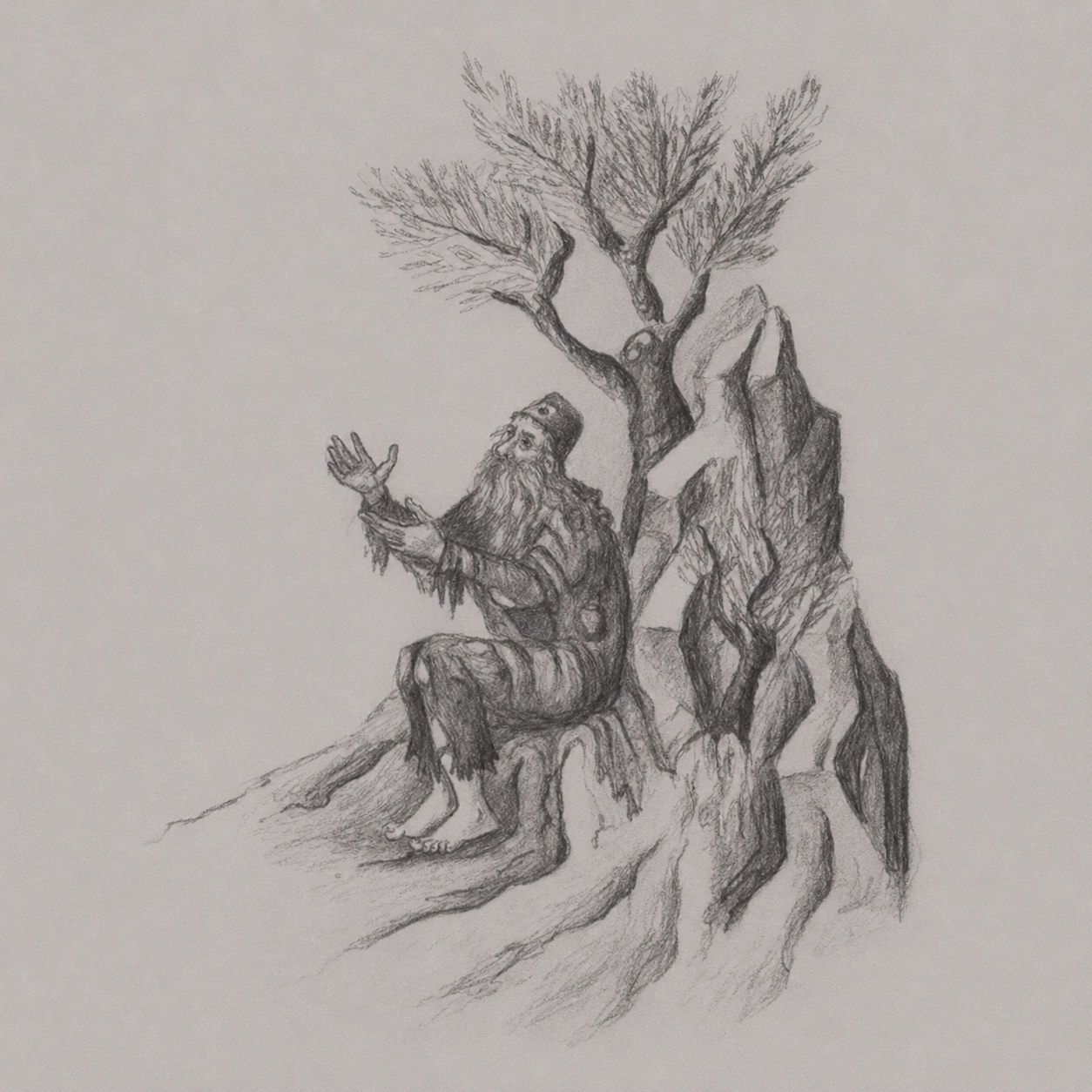
He lived there alone for about three years (1526–1529 A.D.). He ate sparingly, like the birds of the air. The shade of a wild apple tree became his cell. The tree survives to this day. There he was exposed to all kinds of weather. Winter and summer alike, he endured rain, thunder, and storms. He slept on icy rocks, using his torn cassock as his covering.
In time, it became known that a venerable hieromonk was living an ascetic life on the mountainside, and many people came to see him. Some were so moved by his presence that they remained with him and embraced monastic life, forming a small brotherhood.
They built simple huts, cultivated the land, and provided for their needs. They also built a church dedicated to the Holy Trinity, in memory of the church of the same name in Bathyrema, which stood as a spiritual beacon upon the mountain.
Next in this series: Symeon and Triantafyllia: A Story of Confession.
Leave a Reply