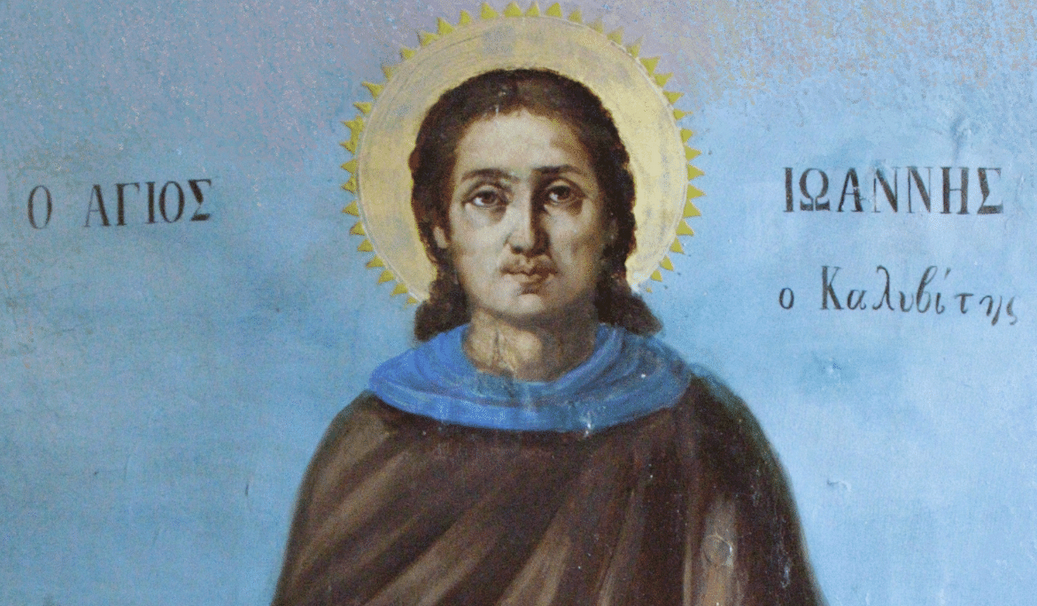
He lived in the fifth century. His title, “Kalyvite,” comes from the Greek word kalyva, meaning “a small hut,” because he lived in such a dwelling.
His life is deeply moving, dramatic, and profoundly instructive. Here is a brief account of it.
His parents, citizens of Constantinople, were wealthy, respected, and devout Christians. They gave their son John a gilded Gospel Book as a spiritual guide for his life. They also hoped he would marry and bless them with grandchildren. However, John secretly left home and became a monk, embracing the life of monasticism and asceticism.
His parents “moved heaven and earth” to find him, but in vain. They did not know whether he was dead or alive.
Meanwhile, John struggled in the monastery through vigils, fasting, and prayer. Yet he was constantly tempted to return and see his parents. He repeatedly begged the Lord to take away this temptation, increasing his fasting and prayer even more. But the temptation remained.
Seeing his suffering, the abbot blessed him to leave the monastery and return to his family home. John accepted the blessing but imposed one condition upon himself: he would not reveal his identity to his parents.
One winter evening, he arrived at his home.
The following morning, a servant opened the gate and saw an emaciated monk standing outside—a living image of extreme asceticism.
“Who are you? What are you doing here at this hour? Go away!”
“I beg you, let me remain in a corner here. I will not disturb anyone.”
And so he stayed quietly by the gate.
A little later, his father came out to leave for work.
“Who are you, my friend?”
“I come from far away. Please allow me to remain outside by the gate.”
“No, my friend! Come inside! Stay in a small room for as long as you wish.”
“I am a monk, and according to the discipline of monastic life, it is not permitted for a monk to stay in a family home.”
“But you will freeze in this cold!”
“The good God will provide.”
That evening, the father returned from work and said to his wife:
“I feel great sorrow for that monk. In this winter cold, he must be suffering terribly. Perhaps God has sent him so that we too may be saved through his prayers.”
Early the next morning, the mother hurried outside to see him. But as soon as she caught sight of him from a distance, she called to the servants:
“Tell him to leave! I cannot bear to look at skeletons like that!”
In the end, however, his parents took pity on him and built a small hut (kalyva) for him.
There he remained until the end of his life: a stranger to the world, a stranger even to his own parents—a hermit in the courtyard of his own home.
Shortly before his death, the Lord revealed to him that in three days He would receive his soul. John then decided to reveal himself to his parents.
He asked his mother to come to the hut, but she could not bear the sight of such an emaciated monk and refused.
“Come,” he said, “or you will regret it later.”
Seeing his persistence, she instructed the servants to carry him into the house, covering him with a sheet so that she would not have to look upon his face.
John entered the house, thanked his parents for their hospitality, and said:
“In three days I shall depart this life. Take this Gospel.”
It was the very Gospel Book his parents themselves had once given him.
Then he returned to his little hut.
When his parents recognized that it was the very Gospel they had once given to their son, they said:
“Let us go and ask him where he got it. Perhaps he knows something about John.”
“I am John,” he told them.
The scene that followed is beyond description.
John then knelt down and prayed to the Lord: “I thank You, my God, for strengthening me throughout the struggle of the ascetic life. I beseech You: strengthen my father and mother, and make them heirs of Your eternal Kingdom. For blessed are You unto the ages of ages. Amen.”And he peacefully surrendered his spirit.
Memory celebrated on January 15 (Source: The Great Synaxarion of the Orthodox Church, Volume I: January 15 – The Life of Venerable John the Kalyvite).
A short reflection
Was it wrong that he did not reveal himself to his parents from the very beginning? No, it was not. Why did he act this way?
Saint Paisios used to say that when we voluntarily deprive ourselves of earthly joys for the sake of Christ, Christ rewards us abundantly for that sacrifice.
Christ will reward us for our sorrows, not for our pleasures.
Leave a Reply