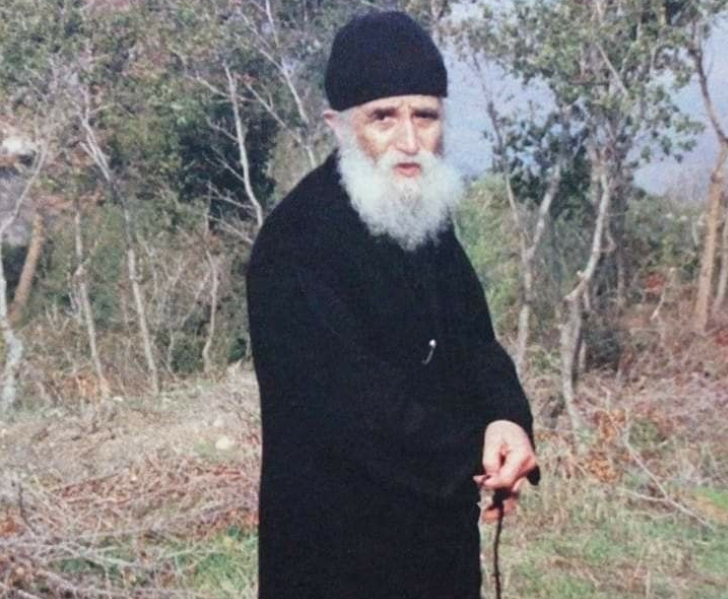
I had the blessing of meeting Saint Paisios the Hagiorite on three occasions. Each of these encounters proved to be a profound and instructive spiritual experience.
First group visit – 1972
In the summer of 1972, a group of students visited Saint Paisios at his remote cell, the Holy Cross, which belonged to the Holy Monastery of Stavronikita on Mount Athos.
The Saint welcomed us, and we sat in the courtyard of his cell and talked. Among other things, the Elder said:
“A murderer may be struggling more than I am. If, for example, he had planned to commit two murders but ended up committing only one, then he has struggled not to commit the second. What struggle do I make—merely to cut off one of my passions? Therefore, do not lose heart because of your passions, nor become proud of your virtues, for God takes into account each person’s struggle against himself.”
At the end, he said:
“I rejoice that I live, and I also rejoice that I will die.”
He rejoiced that he would die because he rejoiced in life; and he rejoiced in life because he had dedicated it entirely to Christ.
Second group visit – 1979
The second meeting with Elder Paisios took place seven years later, in July 1979, at his remote cell of Panagouda. We were a group of young men led by Archimandrite Meletios Kalamaras (later Metropolitan of Nikopolis).
Father Meletios had already decided to settle at the Holy Monastery of Great Lavra on Mount Athos. He was a man of spiritual struggle; fasting and prayer formed the foundation of his priestly life. It was the first time he would meet Elder Paisios.
Around nine in the morning, we arrived at his cell. On the door there was a sign that read:
“I am away. I will return this afternoon.”
“Let us wait a little,” said Meletios, “and if it is God’s will, he will come.”
Five or six young men from our group remained in the courtyard of the cell, while Meletios and a few others, including the writer of these lines, hid in the nearby forest.
Barely ten or fifteen minutes had passed when those standing in the courtyard saw Elder Paisios approaching in amazement. “He is coming! He is coming!” they shouted excitedly.
However, instead of heading toward the courtyard, Paisios noticed people ahead of him, turned left toward the forest, and hurried forward as if sensing a spiritual fragrance. He passed right by us without noticing, ran toward Meletios, bowed, and kissed his hand.
“Those with keen spiritual perception can discern those who carry hidden fragrances,” says St. John of the Ladder (Step 26, On Discernment). Meletios had upon him spiritual aromas, virtues that were fragrant; and Paisios’ pure sense of smell detected the myrrh-like fragrance and sought it out.
We then went down to the courtyard, and the Elder put on his cassock and hat. We sat under the trees, and he said to Meletios: “You came again in 1974, but I was in the mountains. How is Father Agathangelos?”
When Meletios intended to settle on Mount Athos, Elder Paisios did not speak about Athonite monastic life, but rather about missionary work in the world and about monasteries outside Mount Athos. He spoke about many different topics. He said, “If Saint Basil the Great were alive today, he would not build the Basiliad; instead, he would devote all his time to the spiritual cultivation of his flock.” He also said, “When a mother weeps because her child is going to become a monk, she will receive a greater reward than the mother who rejoices because her child is becoming a monk, because the first mother offers her pain to God.” And he said many other things as well.
When it was time for us to leave, the Elder accompanied Meletios as far as the small river, about three hundred meters from his cell, continuing their conversation along the way.
In February 1980, Meletios was elected Metropolitan of Nikopolis. He later carried out missionary work among the people and founded monasteries, with the first monks being young men who had previously visited Elder Paisios.
Third individual visit – 1979
In the same summer of 1979 I personally visited Saint Paisios the Athonite. We were alone, just the two of us. He said to me:
“Whichever path you choose in life—whether marriage or monastic life—follow it with humility.”
When I told him that there are temptations in the world, he replied: “God helps us even more through trials.”
During our conversation on various topics, a man about seventy years old from Konitsa in Epirus arrived, where the Elder had once lived as an ascetic. He was well known to Paisios. This man began to “instruct” the Elder himself, saying all sorts of things, even advising him on how much to eat and how much to sleep. The Elder listened attentively, without complaint and without interrupting him.
When the visitor mentioned a married acquaintance from Konitsa, the Elder nodded meaningfully. At one point, he let out a deep groan and cried out as if he were being cut to pieces, saying from the depths of his heart: “I am not even remotely like him—not even this much,” showing the tip of his little finger.
Although so many years had passed from then (1979) until today (2026), that sorrowful expression on his face is still deeply engraved in my memory. I saw with my own eyes that a saint is one who truly believes in his heart that he is nothing. This sense of unworthiness has nothing to do with inferiority; it is light, resurrection, and divine grace, for the Lord “gives grace to the humble” (Proverbs 3:34).
“Holy Saint of God, intercede for us”. Amen.
Next in this series: The Hermit Who Risked Everything to Save a Soul
Leave a Reply