Shortly before the second exile of Saint John Chrysostom, extraordinary events took place in Constantinople.
In June, a fire broke out from the throne from which Saint John Chrysostom had preached. The flames arched through the air, spread over a great distance, and burned several houses, yet they miraculously avoided harming either people or animals, as though guided by an invisible hand. In September, an unusually severe hailstorm struck the city and its surrounding suburbs. The people interpreted these events as manifestations of divine wrath for John’s unjust deposition (George the Patriarch, Ibid., Chapter 63; Great Synaxaristes of the Orthodox Church, Vol. XI).
These events were regarded as divine signs against the persecutors of Saint John Chrysostom. Nevertheless, their envy and hostility remained undiminished, and they resolved to send him into exile once more.
Saint John Chrysostom continued to preach with unwavering zeal. His deep concern for the poor led him to denounce greed and to emphasize Christian love and charity. However, his bold preaching provoked the anger of the wealthy and powerful.
Shortly before Easter in AD 404, the imperial court forbade Saint John Chrysostom from appearing publicly, arguing that since he had been deposed and condemned, only a synod could restore him.
He remained confined to the episcopal residence. Forty supporting bishops approached Emperor Arcadius and pleaded for his restoration in honor of Easter. Although the Emperor may have been willing to agree, he feared the influence of Empress Eudoxia.
“My daughters,” he said, “my earthly life is drawing to an end. Accept the new bishop; you will not see me again. Remember me in your prayers.”
As he passed through Armenia, local pagans who had heard of his miracles brought before him a paralyzed man, saying:
“If he heals him, we shall believe in his God.”
Immediately, the man was healed. According to tradition, the entire region embraced the Christian faith (George the Patriarch, Ibid., Chapter 59).
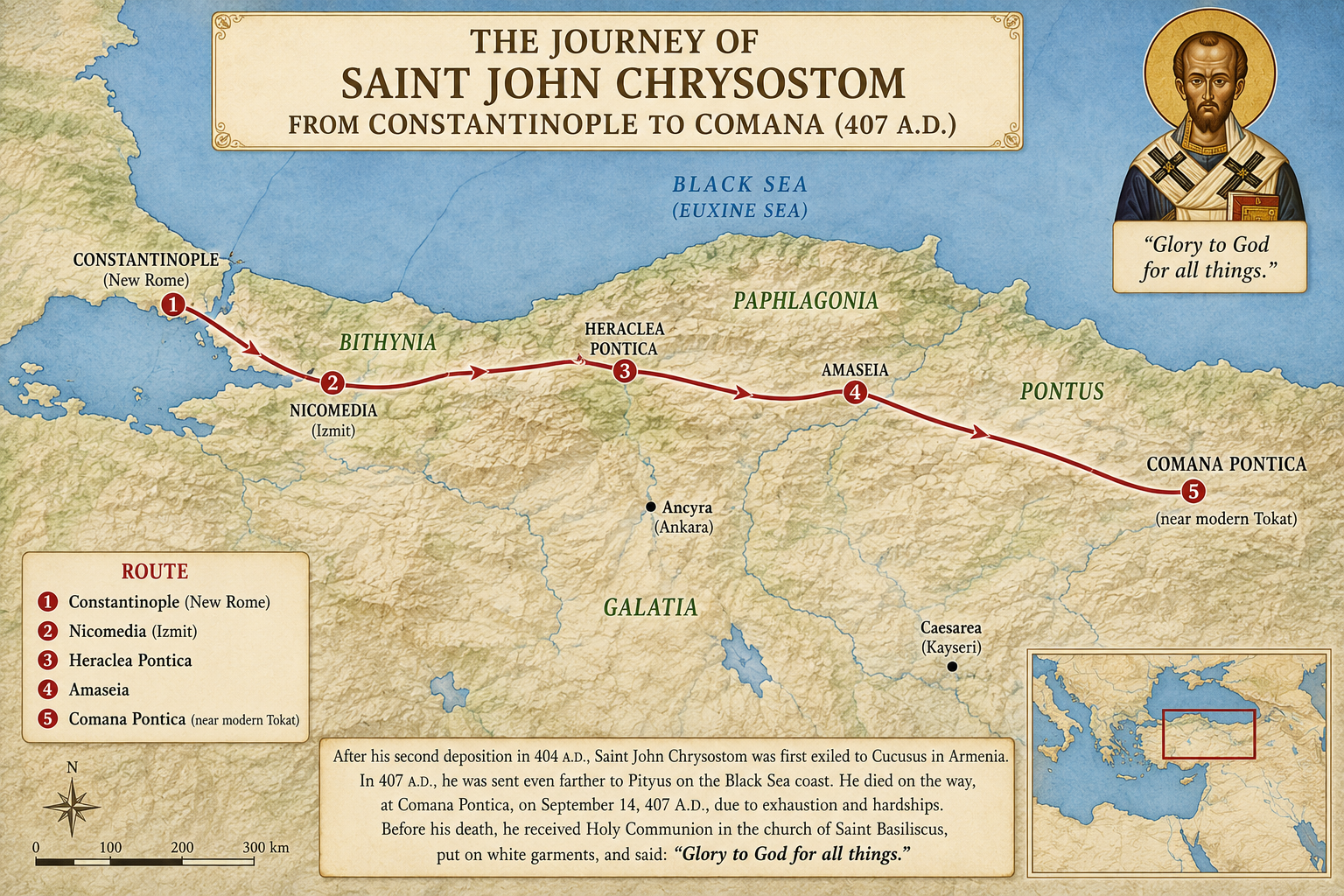
Saint John Chrysostom then continued toward Comana, his final place of exile. His journey became a veritable Golgotha, marked by hunger, exhaustion, hardship, and the cruel treatment of the soldiers escorting him. He endured these sufferings for approximately seventy days.
The dramatic end of Saint John Chrysostom’s enemies
Following Pope Innocent I’s criticism regarding the treatment of Saint John Chrysostom, Emperor Arcadius confined Empress Eudoxia to the imperial palace. Overwhelmed by distress, she suffered a severe hemorrhage (George the Patriarch, Ibid., Chapter 69).
According to ecclesiastical tradition, many who opposed Saint John Chrysostom met tragic ends:One died after being struck on the head by a stone.Another fell from his horse, broke his knee, and died. Another suffered terrifying nightmares and remained sleepless.
Another became mute and paralyzed.Another was consumed by a burning fever.Another suffered severe itching throughout his body.
Another developed swelling in his legs. Another’s tongue swelled and he could no longer speak.Another suffered intense intestinal agony.Another developed severe swelling of his feet.Another’s hands alternated between extreme heat and cold after signing the condemnation.Another became paralyzed and could breathe only in an upright position.Another’s body decayed and emitted an unbearable stench. Empress Eudoxia is also said to have suffered a similar fate. After her hemorrhage, her body allegedly became putrid and emitted a foul odor. Incense and perfumes were used to mask the stench. She is said to have confessed:
“I know why I have fallen ill. It is because of the evil I did to John by sending him into exile. My illness is a punishment from God.” (George the Patriarch, Ibid., Chapter 69).
Tradition further relates that as she approached death, her tomb shook violently (Great Synaxaristes of the Orthodox Church, Vol. I).
Next article in this series: Saint John Chrysostom: Death, Relics, and His Forgiveness of Eudoxia
Leave a Reply