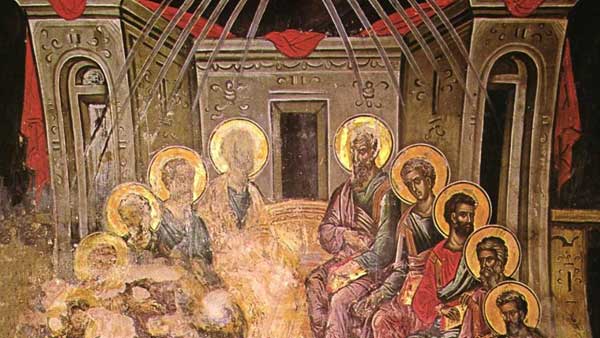
Do we know exactly what happened on the day of Pentecost? The following account describes what took place.
Before His Ascension, Christ instructed His Apostles not to leave Jerusalem, so that they might receive power and wisdom from on high (Acts 1:4, 8). Until that moment, they were faint-hearted. When Jesus was arrested, they abandoned Him (Mt. 26:56). They were also uneducated and slow to understand. At times, when Christ spoke to them, they misunderstood His words: “For they did not understand about the loaves, because their hearts were hardened” (Mk 6:52).
And yet these very men were destined to go forth among wolves—that is, among unbelievers—to preach Jesus Christ. Under such circumstances, they would surely have failed. But shortly before His Ascension, Christ commanded them to remain in Jerusalem until they received power when the Holy Spirit came upon them. Then they would become His witnesses in Jerusalem, in all Judea, in Samaria, and to the ends of the earth (Acts 1:4, 8).
The Transformation of the Apostles
On the great day of Pentecost, the Twelve Apostles were suddenly transformed from timid men into lions, and from uneducated fishermen into wise teachers. Have we truly reflected on this? There is something even more astonishing: this remarkable transformation took place without instruction, study, or training, and in only a fraction of a second.
This happened to all twelve Apostles—twelve men, twelve miracles. Can anyone explain such a transformation? How could twelve uneducated and fearful men, in a matter of moments, be changed so completely as to become unrecognizable? Or even one such man?
An example is Saint Peter the Apostle. Out of fear of a servant girl, he denied Christ (Mt. 26:70). Yet on the day of Pentecost, he stood boldly before thousands in Jerusalem and preached Christ without fear. Though he knew only the trade of fishing and had no formal knowledge of the Scriptures, he preached to the Jews from the Scriptures themselves, quoting by heart passages from the Prophet Joel (Acts 2:17–21; Joel 2:30–31; 3:1) and from David (Acts 2:25–27; Psalm 15:8–11), and explaining them perfectly.
By listening to Peter, “they were cut to the heart” (Acts 2:37). On that very day, about three thousand people believed and were baptized in the name of the crucified Christ (Acts 2:38, 41). Soon afterward, another remarkable event took place: “Many who heard the word believed, and the number of the men came to about five thousand” (Acts 4:4).
When Christ Himself had spoken to these same people, many of them had become enraged and taken up stones to kill Him (Jn 8:59). But now everything had changed. A person often thinks differently before committing a grave act than afterward. Once the deed is done, conscience awakens and guilt begins to speak. This appears to have happened to many of those who had rejected Christ and later heard the Apostles’ preaching.
The Lord had already foretold it unto them: “When ye have lifted up the Son of man upon the Cross, then shall ye know that I am he” (Jn 8:28). Likewise, after the Crucifixion, “all the people that came together to that sight, beholding the things which were done, smote their breasts, and returned” (Lk. 23:48). They believed the matter was finished, yet suddenly their consciences were pierced with guilt.
And when the Apostles had completed their preaching and the mass baptisms in Jerusalem, they went forth to preach also to the Gentiles. These once timid and unlettered men succeeded in transforming the world through the wisdom and power of the Holy Spirit, whom they had received on the day of Pentecost.
A Necessary Clarification
Yet this does not imply that receiving the Holy Spirit instantly makes someone a great theologian. This occurred only once, in the case of the Twelve Apostles. Thus, when an uneducated person is purified and receives the Holy Spirit, he does not automatically become a scholar or theologian, but remains as he was in terms of formal learning.
The saints themselves recognized the distinction between holiness and formal theological learning. When people asked St. Ephraim of Katounakia (Mount Athos) about theological matters, he would reply: “I’m not a theologian. Go to Father Emilianos (abbot of Simonopetra) or Father George (abbot of Gregoriou Monastery); they are theologians and can answer you.”
Similarly, during the time of Arius, when people asked St. Anthony the Great about matters of faith, he would direct them to St. Athanasius, who possessed both holiness and theological learning.
The extraordinary transformation of the Apostles at Pentecost was therefore a unique event in salvation history. Through the descent of the Holy Spirit, fearful fishermen became fearless preachers, and simple men became instruments through whom the Gospel spread throughout the world.
Leave a Reply