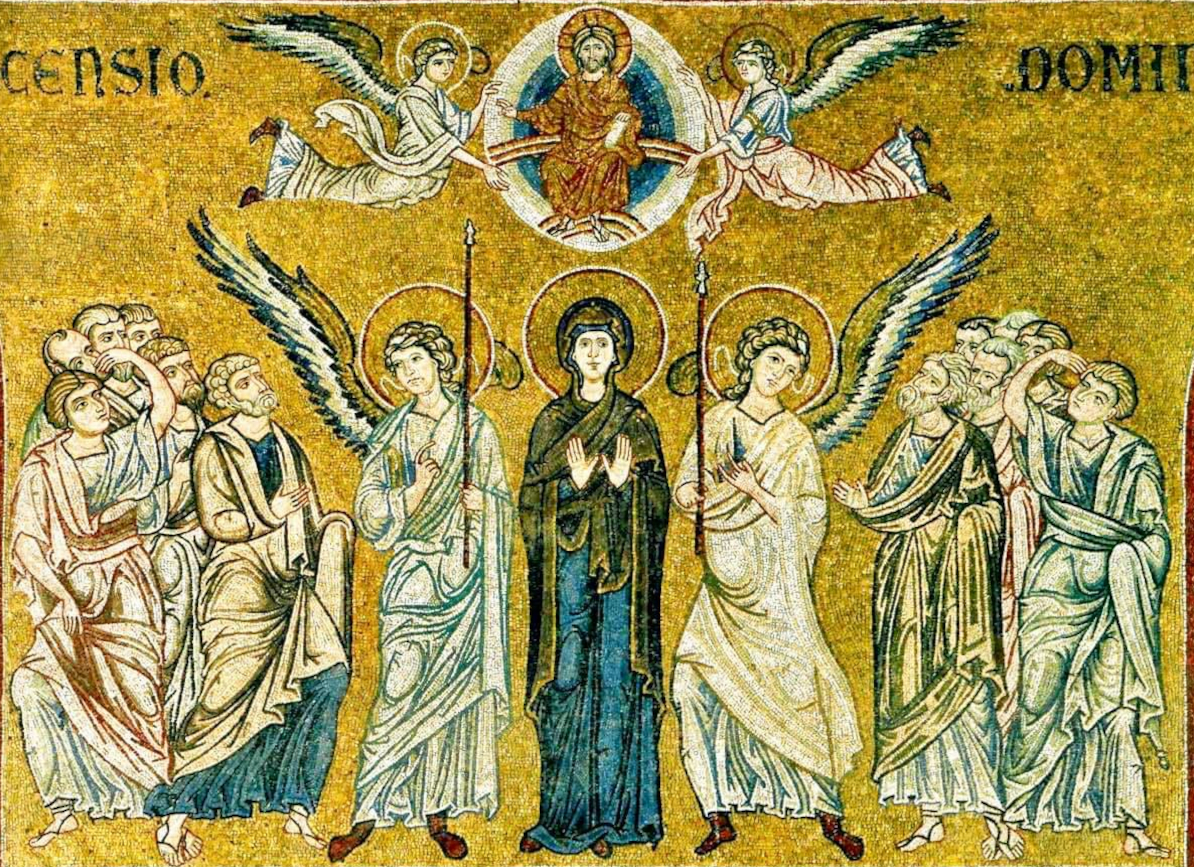
The Lord descended in one form and ascended in another: He descended as God and ascended as both God and Man. Although He ascended into heaven, He did not “discard” His human nature. He continues to bear it forever. He remains united with us. Can we truly grasp what this means?
His all-holy Body was like ours (except, of course, for any inclination to sin) and followed the natural course that every human body follows until death. We may say that there were four stages through which His Body passed until it reached its final glorification.
First: from His Birth to His Crucifixion, He experienced hunger, thirst, fatigue, and similar human limitations (otherwise He would not be truly human). At this stage, His Body was naturally corruptible, insofar as it was subject to weakness and the conditions of human nature. Christ voluntarily submitted Himself to the laws of nature to which every human body is subject until death. Had Christ not been crucified, He would have grown old and died, as is the case with all human beings. Otherwise, His Body would not have been like ours. “As His Body was not incorruptible, it was in all respects like ours.” (John of Damascus, On the Orthodox Faith III. P.G 94:1100)
Second: from His Crucifixion to His Resurrection, His mortal condition culminated in His death and three-day burial. However, even in death there was no decay, corruption, or dissolution of the Body, because His Body remained united with His Divinity. Just as the prophet Jonah was preserved for three days in the belly of the great fish without being consumed (Jonah 2:1–11), so the dead Body of Christ remained in the tomb without corruption. “For You will not abandon my soul to Hades, nor will You allow Your Holy One to see corruption” (Psalms 16:10), meaning that the Body of Christ did not undergo decay in the tomb.
Third: from His Resurrection to His Ascension, we encounter a transformed mode of existence. “Do not touch Me,” Jesus said to Mary Magdalene immediately after His Resurrection (Gospel of John 20:17), indicating that He was no longer as she had known Him before. He now possessed a glorified Body, free from natural passions and no longer subject to hunger, thirst, or fatigue (John of Damascus, On the Orthodox Faith, III, PG 94:1100). His Body was now entirely free from corruption.
Fourth: when Jesus said to Mary Magdalene, “Do not touch Me, for I have not yet ascended to My Father” (John 20:17), He meant that He was about to return to the Father and would no longer be seen in the same way as before. As John Chrysostom explains, He would henceforth be seen differently (Homily 86 on John. P.G 59:469). In other words, at the Ascension of Jesus, His Body became even more perfect; it was deified. “You deified that which You assumed at Your Ascension” (Service of Holy Communion, Prayer of St. Symeon Metaphrastes).
Christ’s Body After His Ascension
He asked this of the Father shortly before His crucifixion: “Father, glorify Me in Your presence with the glory I had with You before the world existed” (John 17:5). As St. John Chrysostom explains, His human nature, His Body, had not yet been fully glorified, nor had it yet entered the fullness of heavenly glory (Homily 80 on John. P.G 59:435). This was fulfilled at the Ascension of Jesus.
He is seated at the right hand of the Father, for in His divinity He is inseparably united with God the Father. As God, He is everywhere present, but as man, He is not. As man, He was on earth in Jerusalem, in a house, speaking with Nicodemus; but as God, He was simultaneously both on earth and in heaven, as He Himself said: “The Son of Man who is in heaven” (John 3:13). The same applies now as well: as man, He is seated at the right hand of God the Father, but as God, He is everywhere present. And wherever He wills, He also manifests Himself bodily, as He did to Paul the Apostle (Acts 9:3–5).
And now, seated at the right hand of God the Father, He continues His work for humanity as the one Mediator between God and mankind (1 Timothy 2:5). Just as Christ prayed on earth as man for His disciples, that they might have love among themselves (John 17:20–21), so too He now intercedes with the Father for His Church and continues to offer Himself in the Holy Eucharist for the salvation of the world, until the end of time, “until He comes again to judge the living and the dead.”
More in this series on Ascension: The Ascension of Christ: His Final Miracle Explained
Leave a Reply