In Greece, until around the 1980s, it was unthinkable for a Greek Orthodox Christian to receive Holy Communion without having fasted for seven days, or at least three days beforehand.
However, certain circles in our country campaigned vigorously to abolish this particular fasting practice, invoking various arguments. They even went so far as to claim that the three-day fast before Holy Communion was an invention of the devil, because it prevented Christians from receiving Holy Communion frequently.
How could fasting, which is a weapon against the devil, possibly be an invention of the devil (Μatthew 17: 21), Did they not consider that the opposite might be true? Could it be that the abandonment of fasting is an invention of the devil?
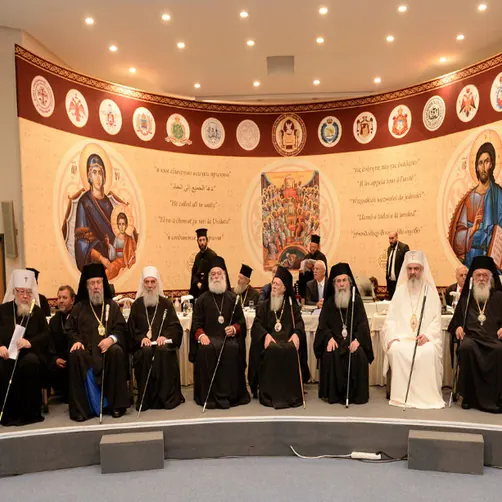
And these circles succeeded in abolishing this fast, not only in our country, but also in Greek-speaking Orthodox Churches abroad. By contrast, in the other local Orthodox Churches, the three-day fast before Holy Communion is still a living practice. Thus, two different practices emerged within the Church concerning this matter. One maintains that fasting before Holy Communion is not necessary, while the other maintains that it is. This gave rise to a problem. This issue was brought before the Pan-Orthodox Council of Crete (2016), and the Council sought to reconcile these two practices.“The observance of a fast of three or more days before Holy Communion is left to the devotion of the faithful… However, all the faithful of the Church are obliged to observe the sacred fasts and to abstain from all food and drink from midnight onwards, in order to approach Holy Communion regularly.”
The essential point is that “the observance of a fast of three or more days before Holy Communion is left to the devotion of the faithful.” But if the devotion of the faithful is not manifested in this most sacred of Mysteries, where else will it be manifested? “Can you fast from meat, dairy products, and fish?” I asked an elderly woman in 1989, when she expressed her desire to receive Holy Communion. “What are you saying, dear Father? For the sake of Christ, I would go without even a drop of oil for an entire week!” she replied.
Such reverence for the Holy Mystery!
The following account is even more revealing.
The Very Reverend Archimandrite Chariton A. recounts the following incident. In a remote village of Northern Epirus, on the eve of the Feast of Theophany in 2000, while he was blessing the homes, a mother from Northern Epirus said to him:
“My daughter is bedridden and paralyzed. For the past two years, she has not eaten meat, nor has she consumed oil on Wednesdays and Fridays, hoping that one day she might find a priest who could give her Holy Communion. Now that you have come, would you be able to give her Holy Communion?”
Father Chariton hastened to the nearest church and brought the Holy Gifts. As he approached the sick young woman to administer Holy Communion, her face suddenly shone with a brilliant light. All he could see was light. He could not even distinguish her mouth in order to administer Holy Communion.
What is remarkable is not that her face shone because she had received Holy Communion, for what could be more natural for an Orthodox Christian who receives the Holy Mysteries worthily?
Rather, what is truly remarkable is that her face shone before she had even received Holy Communion!
Why? Because she had shown profound reverence for the Body and Blood of Christ. And this was pleasing to the Lord. For her, it was Holy Communion before Holy Communion itself!
Leave a Reply