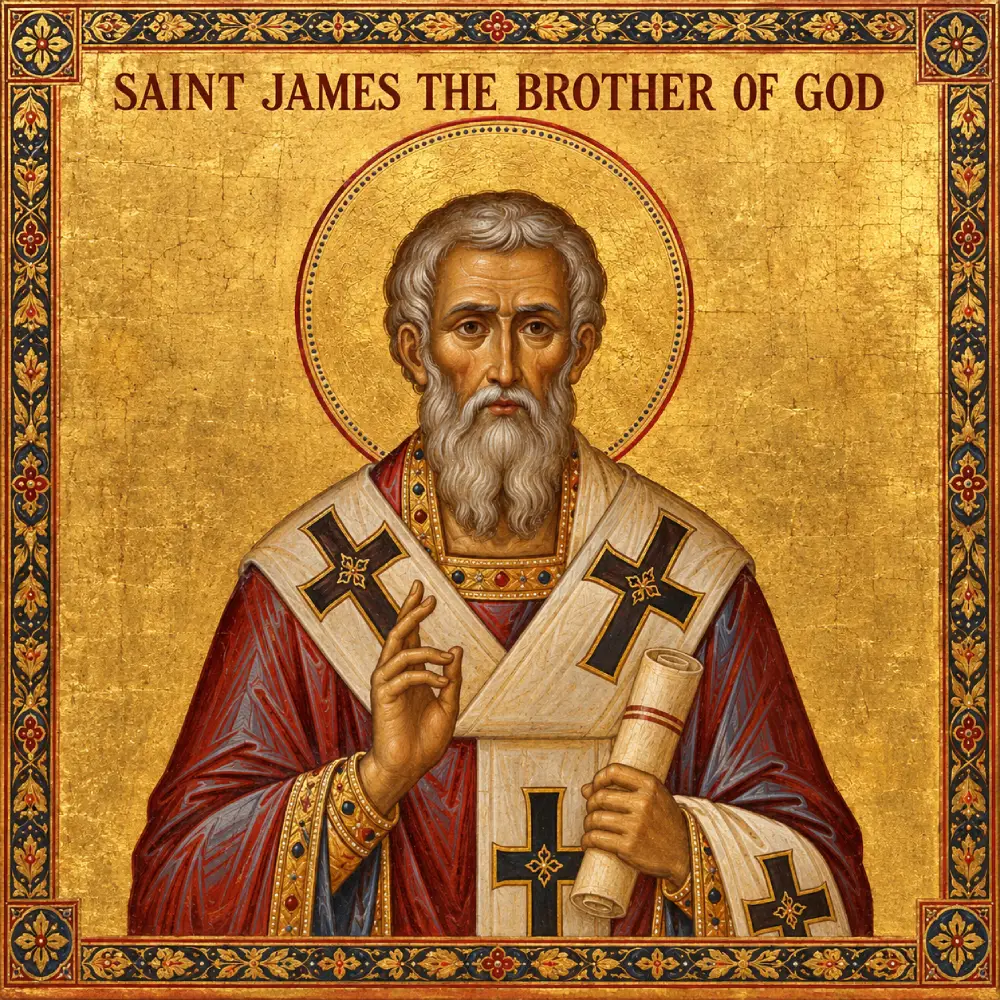
October 23 is the commemoration of the Holy Apostle James, the Brother of the Lord. In many local Orthodox Churches, the Liturgy of Saint James is celebrated. Indeed, as they say, this Liturgy is celebrated in the way it was celebrated in the Church.
Let us examine this.
The Liturgy of Saint James currently in use was composed between the fourth and sixth centuries. This is evidenced by the following: Until the sixth century, the Litany of Peace, or Great Litany, was said after the Thrice Holy Hymn. In the Liturgy of Saint James, the Litany of Peace is said after the Thrice Holy Hymn, so it was written before the sixth century. Constantinople and its emperors are also mentioned in this Liturgy, proving that it was written between the fourth and sixth centuries. In other words, there is no Divine Liturgy written by the Apostle James himself.
Let us consider this a secondary matter. What is of great importance is the claim that the Liturgy of Saint James is celebrated as it was in the ancient Church. At that time, the order for celebrating the Sacrament in the ancient Church was, in brief, as follows.
Men entered the church through a different door from women. Men stood in the front row, and women stood behind them. When the celebration of the Holy Eucharist began, the catechumens and those who would not receive Communion left the church. Only those who would receive Communion remained.
They did not receive Communion in the same way it is received today in the Liturgy of St. James. They received Communion on their knees and remained kneeling until all the faithful had received Communion. None of these things takes place in the Liturgy of Saint James. That is, the Divine Liturgy of Saint James is not celebrated in the way it was celebrated in the ancient Church. If only it were! The faithful would learn many things.
There is more.
At that time, the ancient Church did not have the Gospel book in the form in which we have it today and use it in the Liturgy of Saint James. The Proskomedia in the Liturgy of Saint James is not performed as it was in the ancient Church. Likewise, neither the Little Entrance nor the Great Entrance is performed as it was in the ancient Church.
Let us overlook these things as well and consider them secondary matters. However, other things take place that alter the mystagogical character of the Liturgy.
Saint Basil the Great declares that turning towards the east when we pray is an ancient tradition (Saint Basil the Great, On the Holy Spirit, 27, 66, PG 32:192). Yet in the Liturgy of Saint James, the priest turns towards the west! If only that were the only issue!
From the beginning, the Liturgy was celebrated “with the doors closed,” following the example of the Mystical Supper, that is, away from the eyes of the laity. Only the priest celebrating the Liturgy could see the Sacrament. Yet in the Liturgy of Saint James, precisely the opposite takes place—something unprecedented in Orthodox tradition.
The Sacrament takes place “openly.”
Something else also happens. The Holy Table is consecrated for the celebration of the Sacrament. How can we celebrate the Sacrament on an ordinary table when we have a consecrated Holy Table? Why do we despise the Holy Altar? Oikonomia (“judicious economy”) is applied when strict observance is impossible. Otherwise, we are not applying “judicious economy” but acting arbitrarily.
We use the antimension (from the Greek ἀντιμήνσιον, “instead of the table,” an altar cloth). The antimension is intended for a time of need and does not replace the church building or the Holy Table. Otherwise, what is the reason for consecrations? In light of all the above, why should the Divine Liturgy be celebrated in this way?
People benefit when we observe what we have received, not when we despise it. Saint Symeon, Archbishop of Thessalonica, states: “If we bear in mind and observe the works of the Fathers, then their grace will also be with us” (All His Works, Part II, chapter 4, “Preaching Must Lead the Faithful to Repentance”)
Leave a Reply