
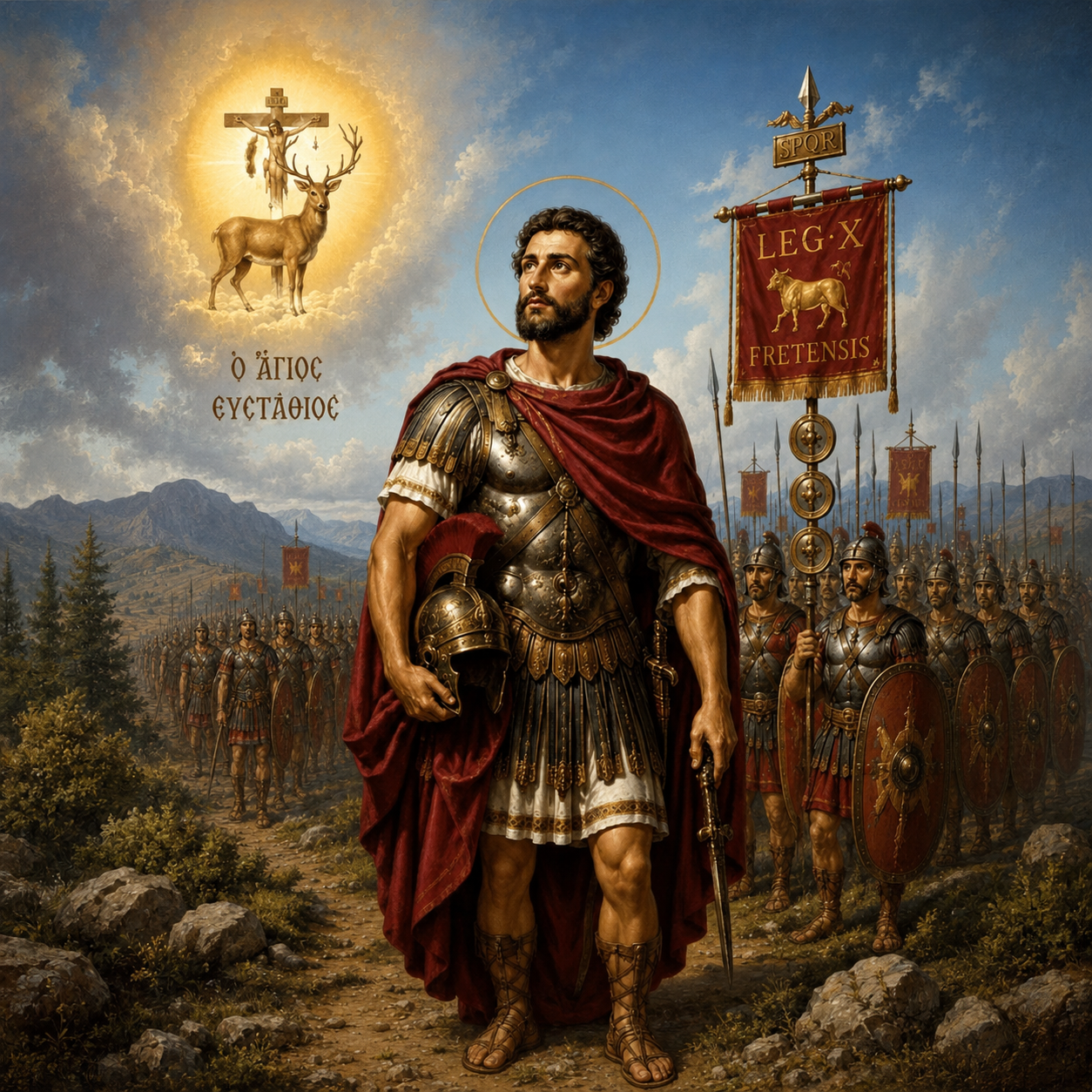
We begin a new series of articles on the miraculous life of Saint Eustathius the Great Martyr and his family. Before his conversion, Eustathius was known by his pagan name, Placidus, and served as a general in the Roman army.
The Lord, Who knows the depths of the human heart, saw the faithfulness and goodness within Placidus and called him.
God called Moses through the burning bush, and this was not without meaning. Moses was a shepherd and was familiar with the wilderness and its plants. In the same way, God called Placidus through a deer, using something familiar to his own life, as hunting deer was one of his favorite pastimes.
The Strange Deer
Ancient Rome was a pagan society, where many people had grown accustomed to violence and cruelty. Imagine thousands of people gathered at the Colosseum to witness the suffering and death of Christians as a public spectacle.
In this empire marked by violence and cruelty, toward the end of the first century, the Roman general Placidus was born and raised. Yet he was very different from the society around him. His soldiers respected and admired him.
His favorite pastime was hunting, especially deer. He would gather a small group of soldiers, and together they would ride into the mountains.
One morning, while hunting, a magnificent deer suddenly appeared before him. Placidus shot an arrow, but he missed. The deer disappeared into the forest, and he pursued it on horseback. It ran swiftly through the dense trees, leaping gracefully through the wilderness. From time to time, it turned its head and looked back at the general, almost as if it were inviting him to continue the chase.
Soon the soldiers caught up with him, but they became exhausted by the relentless pursuit.
“Rest here,” the general told them. “I will continue after it alone.”
He rode on as the deer led him deeper into the wilderness until it reached a deep gorge. With a single leap, it crossed over to a small green meadow on the other side. There it stopped and remained completely still, like a statue, gazing at Placidus, who was unable to cross the ravine.
The deer stood before him in silence. Suddenly, a miraculous light appeared, and Placidus heard a voice calling his name. It was the voice of Jesus Christ.
Jesus: “Placidus, I am Jesus Christ, the One who was crucified and rose from the dead.”
Placidus: “I know that You are the true God, the Creator of the world.”
Jesus: “Yes. Yet I seek a place to dwell.”
Placidus: “No place to dwell?”
Jesus: “I am seeking a heart in which I may dwell.”
Placidus: “Then I offer You my new villa.”
Jesus: “You have a compassionate heart. You have fed My poor, and your mercy has drawn Me to you. It is in your heart that I desire to dwell.”
Jesus: “After your baptism, return here. I will be waiting for you, for I have more to tell you.”
Placidus secretly received baptism in Rome together with his wife and their two sons. At his baptism he received the Christian name Eustathius, a Greek name meaning “steadfast” or “firm.” Throughout the many trials that followed, he remained steadfast and faithful to Christ.
His wife received the name Theopiste, which means “faithful to God.”
Jesus teaches Eustathius
Jesus was already waiting for Eustathius at the ravine.
Jesus: “Blessed are you, for you have received baptism, and now you belong to Me.”
Eustathius: “I thank You with all my heart, for You have delivered me from deception. I was living in darkness, and You have brought me into Your light.”
Jesus: “What does a loving father do for his child? He disciplines him, guides him, and helps him grow. So it is with Me.”
Eustathius: “This is what I desire—to struggle. I do not want merely to exist; I want to truly live. True life does not come without effort. I would rather struggle than seek an easy path that leads to being overcome by darkness.”
Jesus: “I have told My disciples: ‘Whoever desires to come after Me, let him deny himself, take up his cross, and follow Me’ (Mark 8:34). A life without the Cross leads to death, but a life with the Cross leads to the Resurrection.”
Eustathius: “I entrust myself and my whole life to You.”
Jesus: “You have courage in your heart. You will pass through your own Golgotha, and afterward you will know the great joy of the Resurrection.”
Eustathius: “I will need Your help.”
Jesus: “Can a woman forget her nursing child, and have no compassion on the son of her womb? Surely she may forget, yet I will never forget you.” (Isaiah 49:15)
Eustathius: “May Your will be done.”
Eustathius bowed down and worshipped the Lord. Then he returned home.
Next in this series: The Family of Saint Eustathius: Trials of Faith
Leave a Reply