
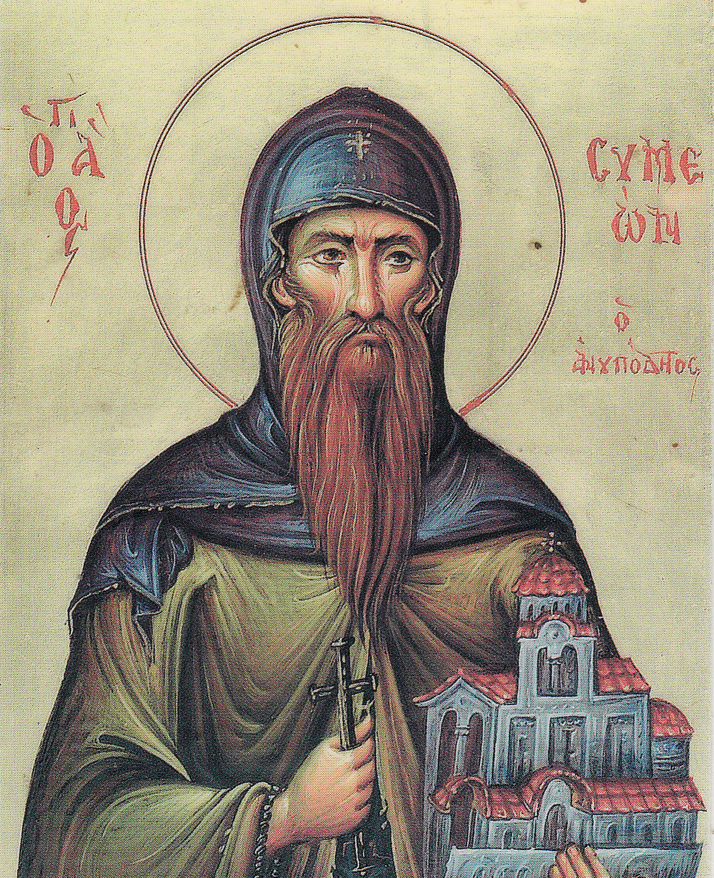
This marks one of the most painful trials in the life of Saint Symeon the Barefooted.
The newly married couple began their life together. They worked hard in their village, in the vineyards, in the fields, and among their livestock to earn their livelihood. Time passed. However, Symeon had made a vow to remain a virgin. Would he keep that vow while living beside the beautiful Triantafyllia? He explained his vow to her, and Triantafyllia agreed that they would live together as brother and sister.
Her father, however, was constantly anxious, fearing that the couple might be living in continence. As long as his daughter did not conceive, he remained deeply troubled.
Triantafyllia would go out to the fields and the mountain slopes where she tended her sheep. The local gamekeeper would often pass by, see the beautiful Triantafyllia, and greet her. Gradually, she began to develop feelings for him. She started making frequent visits to the fields and mountains, and he did the same.
Little by little, passion was kindled, and Triantafyllia became pregnant. Her father finally breathed a sigh of relief.
Triantafyllia could deceive everyone—but not her own conscience, nor, of course, Symeon the Barefooted.
Symeon, humble and self-controlled, restrained not only his flesh but also his tongue. Not wishing to pour salt on an open wound, he remained silent. He withdrew into himself for two or three days, without food or water. (Her sin, he considered, had become his burden.) He then continued his peaceful coexistence with Triantafyllia until she gave birth to the child.
“The monk has fathered a child!” the people gossiped. Symeon, however, remained silent.
Immediately after the forty days of purification, Triantafyllia baptized her son, naming him Demetrios. Her father wished to celebrate the event and invited everyone.
Symeon and Triantafyllia were both in a state of deep sorrow, especially Triantafyllia. On such a festive day, her father could not bear her silence and despondency, and his thoughts turned toward Symeon. He could no longer endure what he perceived as dishonor.
Half drunk, he suddenly exploded at Symeon.
“Why are you not drinking wine, you good-for-nothing? Are you afraid I will poison you? On the one hand you spoke of becoming a monk in the desert, and on the other you came to my house at night and married my daughter! Where is your vow, you donkey, the vow you gave to Christ that you would remain a virgin?”
The guests began to mock Symeon. He then turned to Triantafyllia’s father and said:
“What are you talking about? Did I come to your house, or did you send your men to seize me and bring me there, forcing me into marriage against my will in the middle of the night?
Know this: although you married me against my will, I have kept my vow to my Master Christ. I did not regard your daughter as my wife, but as my sister. And know also that the child she holds in her arms is not mine. It is you who are responsible for what has happened, for you forced this marriage upon us. Do you understand?”
Then he looked directly at Triantafyllia and said:
“Lift the child as high as you can, so that all may see him.”
As the child was raised up, Symeon asked:
“Little Demetrios, tell us—who is your father?”
And the infant, by divine permission, cried out:“The gamekeeper!”
In those days, such a disgrace was considered unbearable. Had anyone been exposed in this way, they would have wished the earth to swallow them alive. One can only imagine Triantafyllia’s anguish after this astonishing revelation, spoken by the lips of her own infant son. Even her father—who until that moment had taken pride in her honor—turned against her, crying out:“You filthy dog! You have brought shame upon our family!”
Next in this series: Symeon Becomes a Monk
Leave a Reply